
Quick Answer
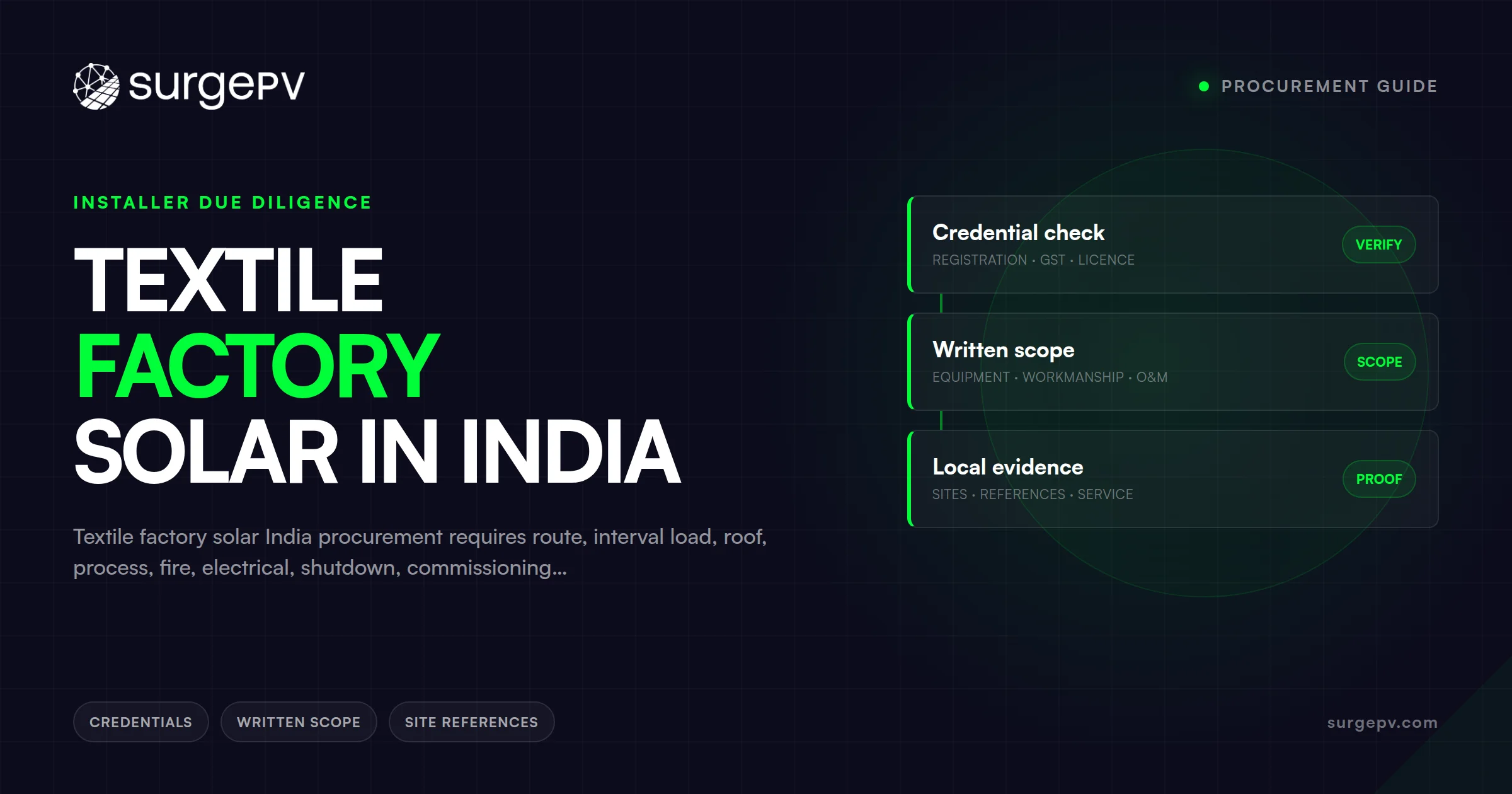
A textile factory solar project in India should begin with the exact bill, licensee, commercial route, interval load, production schedule, and site evidence. Buyers should verify roof, structure, process conditions, fire, EHS, electrical integration, PCC, export behavior, and shutdowns. They should also verify commissioning, lifecycle economics, O&M, and service before contracting.
A textile factory solar project in India should begin with the exact bill, licensee, commercial route, interval load, production schedule, and site evidence. Buyers should verify roof, structure, process conditions, fire, EHS, electrical integration, PCC, export behavior, and shutdowns. They should also verify commissioning, lifecycle economics, O&M, and service before contracting.
Textile solar is an industrial integration project. The array must fit the factory’s operating model without weakening production, electrical safety, roof performance, fire strategy, or maintenance access.
Spinning, weaving, knitting, dyeing, printing, finishing, garments, warehouses, and utilities do not share one load or risk profile. Site evidence must control.
This guide provides a procurement method. It does not provide project-specific engineering, safety, legal, tax, tariff, finance, or investment advice.
Use six textile factory solar India acceptance gates
Give every bidder the same controlled project pack. Do not compare prices until route, scope, evidence, and acceptance are aligned.
| Gate | Buyer question | Minimum evidence |
|---|---|---|
| Route | Which legal and commercial arrangement applies? | Bill, entity, pincode, licensee, voltage, tariff, ownership, state, and current route evidence |
| Load | How does solar coincide with production? | Clean interval data, shifts, shutdowns, seasons, expansion, and sensitivity cases |
| Site | Can the roof, structure, environment, and access support the work? | Survey, condition, load path, fire, process-zone, and unknown-condition registers |
| Electrical | Can the plant connect and operate safely? | Current SLD, PCC, transformer, protection, export, power-quality, and operating-mode studies |
| Delivery | Can construction protect production and workers? | Responsibility, shutdown, EHS, QA, commissioning, handback, and change plans |
| Lifecycle | Is cost, O&M, warranty, service, and exit evidence acceptable? | Normalized bid, sensitivity model, obligations, remedies, data, archive, and decommissioning |
No gate is satisfied by a generic factory proposal. Each result should trace to the actual legal entity, site, load, bill, equipment, and responsible reviewer.
Choose the route before sizing equipment
Possible routes include behind-the-meter CAPEX rooftop, rooftop RESCO or PPA, captive or group-captive, open access, ground mount, and carport.
Storage, backup, retrofit, expansion, roof replacement, and efficiency projects are separate decisions. They can coexist, but each needs its own boundary and economics.
Start with the factory legal entity, latest bill, consumer number, pincode, licensee, voltage, phase, tariff category, sanctioned demand, transformer, PCC, and metering.
Record the export state, ownership, roof rights, lease, lender, insurer, authority, and applicant. Do not infer these from a site address alone.
Define the buyer objective. It may be self-consumption, energy cost, demand management, customer requirements, decarbonization, resilience, roof use, or asset replacement.
Each objective creates different measures. A behind-the-meter array does not automatically solve outage resilience or reduce billed demand.
The Ministry of Power rules discovery page lists Green Energy Open Access Rules and amendments.
Current state regulations, commission orders, SLDC procedures, licensee rules, charges, captive treatment, and agreements still control the project.
Do not apply household subsidies, residential net-metering, another state’s tariff, another licensee’s form, or an unrelated factory’s economics.
CAPEX and third-party ownership need separate commercial analysis. See CAPEX versus RESCO solar in India.
Map the textile process and production interfaces
Create a process map before analyzing electricity. Record actual buildings, lines, utilities, operating hours, critical loads, maintenance, and planned changes.
Possible areas include spinning, weaving, knitting, processing, dyeing, printing, finishing, garment work, warehouses, laboratories, and offices.
Utilities may include compressed air, HVAC, chillers, pumps, boilers, process auxiliaries, effluent treatment, water systems, lighting, and material handling.
Do not infer that every textile site contains these processes. Mark each area as measured, documented, planned, excluded, or unknown.
For every area, record production owner, operating window, shutdown constraint, electrical feeder, environment, fire controls, maintenance access, and change forecast.
Map dependencies. A compressor, pump, chiller, effluent system, or ventilation fan may support several production lines.
Identify production conditions that affect construction. Examples include contamination limits, clean areas, hot surfaces, chemical storage, fibre movement, traffic, and restricted access.
Create a factory interface matrix connecting operations, EHS, maintenance, security, production, EPC, subcontractors, roofing, structure, lifting, electrical, and commissioning.
Build a defensible interval-load model
Collect bills, interval or meter data, feeder and submeter records, shifts, weekly patterns, seasons, shutdowns, holidays, and maintenance.
Also record production changes, planned equipment, captive generation, generators, storage, outages, and power-quality events for a defined period.
Separate energy, maximum demand, contract demand, import, export, reactive energy, power factor, time blocks, demand charges, energy charges, and surcharges.
For open-access or captive evaluation, add the current state, licensee, SLDC, agreement, losses, banking, scheduling, and charge evidence that actually applies.
Clean data using retained rules. Address gaps, timezone errors, meter resets, estimated bills, outliers, outages, production stops, new equipment, and abnormal periods.
Do not delete inconvenient values silently. Preserve raw data, transformed data, rules, exclusions, versions, owners, checks, and sensitivity cases.
Model solar-to-load coincidence by interval. Annual consumption alone hides weekends, low-load shifts, maintenance stops, holidays, seasonal production, and export exposure.
Test low-load, zero-export, export, curtailment, outage, planned expansion, lost shift, and roof-unavailable cases.
Do not promise self-consumption, demand reduction, a zero bill, savings, or production compatibility from incomplete data.
The commercial solar self-consumption guide covers interval coincidence in more depth.
Audit the roof and structural load path
Record roof type, age, remaining-life plan, geometry, slope, spans, purlins, trusses, frames, sheets or decks, fasteners, and existing loads.
Also map skylights, vents, gutters, drains, parapets, equipment, fire paths, maintenance paths, leaks, corrosion, alterations, and waterproofing.
Use measured surveys, current drawings, photographs, material evidence, condition records, and authorized investigations. Mark inaccessible and conflicting areas.
The structural scope should address project design criteria, mounting reactions, attachments or ballast, local members, global load path, deflection, stability, drainage, and ponding.
It should also address corrosion, waterproofing, fire access, construction sequence, maintenance, and future removal where applicable.
Give every unknown an investigation method, safe-access plan, owner, deadline, effect, fallback, and stop condition.
Separate roofing, waterproofing, structural, racking, electrical, fire, construction, and maintenance responsibility.
If roof repair or replacement is expected, evaluate it before solar. Define removal, reinstallation, warranty, access, and production interruption over the project horizon.
Use the solar structural engineering services guide for deeper load-path and investigation controls.
Classify textile environment by zone
Inspect lint, fibre, dust, oil mist, humidity, condensation, heat, chemical vapour, dye or process emissions, corrosion, vibration, pests, and wastewater exposure.
Include salt exposure only where site location and evidence support it. Do not label the whole factory hazardous or benign.
Create zones from measured or documented conditions. Record source, date, operating state, sampling limits, owner, equipment implications, and required review.
Check exact equipment enclosure, temperature, derating, ventilation, clearance, coating, corrosion suitability, fire behavior, ingress limits, and manufacturer instructions.
Check connectors, cables, glands, conduits, trays, supports, junctions, inverters, panels, and communications equipment for each intended zone.
Lint and dust can accumulate on modules, cooling openings, panels, cable trays, and access paths. Define an inspection and cleaning basis.
The method should address isolation, access, PPE, cleaning tools, water or dry methods, chemical compatibility, waste, weather, production, and evidence.
Frequency should respond to observed condition and manufacturer limits. Do not publish one cleaning interval for every textile site.
Process or hazardous-area classification, fire strategy, chemical compatibility, insurer requirements, and statutory duties need qualified site-specific review.
Map the current electrical network and PCC
Collect the current SLD, transformers, HT and LT switchgear, buses, feeders, cables, protection, and meters. Add capacitor banks, generators, UPS, and storage.
Record drives, motors, relays, settings, available fault information, earthing, lightning protection, SCADA, monitoring, and communications.
Define the proposed solar connection point, voltage, phase, transformer or bus capacity, metering, export or zero-export behavior, and reverse-power logic.
Document maintenance states, shutdowns, future expansion, generators, storage, transfer, and islanding limitations.
The electrical scope may include exact-model strings, inverter inputs, AC sizing, cable ampacity, voltage drop, protection, short-circuit, and coordination.
It may also include earthing, lightning interfaces, power quality, harmonics, reactive power, export controls, metering, communications, and settings.
Do not imply every study is included. Name the technical owner, method, input, reviewer, and accepted output.
Textile factories can contain drives, motors, capacitor banks, generators, and nonlinear loads. Measure or study power quality where the project scope requires it.
A grid-tied inverter does not supply factory loads during an outage by default. Backup requires defined storage, transfer, control, protection, earthing, and islanding architecture.
Use solar electrical engineering services for detailed scope controls. Commercial solar transformer sizing addresses transformer-specific interfaces.
Verify official and licensee routes narrowly
The exact bill and pincode identify the legal licensee. The voltage, capacity, ownership, commercial route, and state then guide current requirements.
The CEA safety-regulation page provides current national regulation discovery.
The CEA Chief Electrical Inspectorate overview describes national CEI functions. It does not prove which inspection route applies to one factory.
Project duties may involve a licensee, state regulator, SLDC, electrical inspectorate, meter agency, applicant, professional, contractor, EPC, supplier, and factory.
Only include applications, studies, design reviews, protection reviews, meter changes, agreements, tests, witness points, export permissions, and recurring reports when current evidence requires them.
Do not promise approval, meter timing, export settlement, open-access treatment, captive treatment, or recurring charge outcomes.
Retain every submission, response, comment, revision, agreement, setting, test, meter record, permission, and ongoing duty with dates and owners.
Freeze exact equipment and design artifacts
Create a controlled register for modules, inverters or PCS, racking, storage, transformers, switchgear, protection, meters, export controls, cables, and connectors.
Also control earthing, lightning protection, monitoring, SCADA, communications, sensors, weather equipment, and network devices where applicable.
For each item, record manufacturer, model, revision, quantity, rating, environmental limits, current certificates, installation manual, warranty, authorized supply, and serial traceability.
Record service route, spares, firmware or configuration, monitoring account, compatibility, owner, checker, approver, and limitations.
The design pack can include layouts, shading, generation models, stringing, SLDs, structures, cable schedules, protection schedules, roof details, and fire access.
It can also include monitoring, SCADA, construction, commissioning, O&M, labels, calculations, schedules, and BOMs.
Every input needs a source, revision, date, owner, checker, approver, assumption, limitation, validity, and change history.
Substitution should reopen technical, structural, fire, electrical, grid, export, monitoring, warranty, price, schedule, construction, commissioning, and authority review.
The commercial solar system design guide covers coordinated design choices. Factory solar system design covers factory-wide design depth.
Plan construction around production and EHS
The factory controls operational access and shutdown windows. The EPC should not assume production can stop when construction needs it.
Define induction, access, permits to work, lockout or tagout, electrical isolation, fall protection, lifting, work at height, hot work, and fire watch.
Also address chemical or process areas, traffic, housekeeping, lint, dust, waste, weather, emergencies, incidents, and stop-work authority.
DGFASLI’s official mission page describes central factory, construction, safety, health, and environment functions. Actual state and site duties still require qualified review.
Distinguish full shutdown, feeder shutdown, bus or panel shutdown, local isolation, roof-zone closure, production-line pause, live adjacent equipment, and no-shutdown work.
Only approved safe methods apply. A no-shutdown preference cannot override isolation, safety, equipment, or professional requirements.
Schedule surveys, lifting, penetrations, cable pulls, switchgear changes, testing, energization, and commissioning around controlled windows and contingencies.
Define production handback. Record scope complete, isolations removed, protections restored, areas cleaned, hazards closed, tests passed, documents updated, and factory authorization.
Incoming inspection and QA should cover set-out, structural work, waterproofing, torque, cables, connectors, trays, fire stopping, labels, earthing, panels, meters, monitoring, and SCADA.
Use hold, witness, inspection, test, nonconformance, correction, reinspection, change, shutdown release, and unresolved-item controls.
Issue one RFP and normalize every bid
The RFP should state the route, site, interval load basis, design maturity, equipment, roof, structure, electrical system, and PCC. Add export and approval responsibilities.
It should also state shutdowns, production constraints, EHS, QA, commissioning, monitoring, SCADA, O&M, cleaning, warranties, spares, service, exclusions, and acceptance.
Normalize these cost and scope rows:
- modules, inverters or PCS, racking, and storage;
- roof repair, structure, civil, and drainage;
- DC and AC BOS, HT work, transformers, and switchgear;
- protection, metering, export controls, monitoring, and SCADA;
- studies, design, applications, construction, and logistics;
- shutdown, EHS, QA, testing, commissioning, and handback;
- taxes, insurance, finance, O&M, cleaning, and spares;
- replacements, data, decommissioning, and owner work; and
- exclusions, provisional items, unknowns, and change rules.
Mark each item as included, excluded, quoted, provisional, estimated, official, measured, modeled, or unknown.
The contract should name legal parties, site, scope, design, equipment, procurement, applications, construction, shutdown, EHS, QA, and commissioning.
Also define monitoring, O&M, warranties, data, service, price, taxes, payment, schedule clocks, dependencies, changes, default, termination, dispute, transition, and exit.
Use industrial solar installation company for bidder prequalification. Use solar EPC company in India for broader EPC governance.
Maintain one project risk and decision register
Keep commercial, production, roof, process, fire, electrical, grid, construction, and lifecycle risks in one controlled register.
For every risk, record the source, date, zone, affected asset, production effect, safety effect, probability method, consequence method, owner, and reviewer.
Also record the planned control, residual risk, evidence, due date, stop condition, escalation, decision, approval, and closure.
Examples can include missing interval data, uncertain roof framing, corrosion, lint accumulation, unavailable shutdowns, insufficient switchgear evidence, and export restrictions.
Other examples include long-lead equipment, a proposed substitution, licensee comments, meter delays, contractor interfaces, access conflicts, roof leaks, and production expansion.
Do not hide a risk inside a general exclusion. Assign the owner work, deadline, decision effect, and fallback before contract acceptance.
Use a linked decision log for route, capacity, PCC, equipment, roof repair, shutdown method, export policy, cleaning, service, and commissioning choices.
Each decision should cite the accepted evidence, alternatives, assumptions, affected documents, responsible approver, and review trigger.
Set project stop criteria before mobilization. Stop or hold affected work when site evidence conflicts, isolation is unavailable, equipment differs, or safe access fails.
The same rule applies when authority conditions, roof damage, fire routes, live equipment, weather, or process conditions fall outside the approved method.
Restart only after investigation, qualified review, approved instruction, document revision, distribution, and required reinspection.
Model lifecycle economics with sensitivities
Use the current tariff and cleaned interval-load case. Record every tariff source, date, unit, charge, tax, surcharge, demand rule, export treatment, and uncertainty.
Model generation inputs, degradation, soiling, temperature, clipping, availability, curtailment, export, shutdowns, and future production.
Add demand effects, O&M, cleaning, insurance, replacements, roof work, taxes, finance, delay, downtime, data, and decommissioning.
Separate known, quoted, official, measured, modeled, estimated, and unknown values. Do not hide unknowns inside a confident total.
Run sensitivities for load, generation, tariff, export, CAPEX, delay, downtime, degradation, O&M, replacements, tax, finance, and curtailment.
Do not publish a national cost, rupees-per-kilowatt range, universal tariff saving, payback, IRR, production increase, or bill reduction.
The industrial rooftop solar cost guide provides a detailed lifecycle worksheet. Commercial solar monitoring metrics covers post-operation evidence.
Commission, hand over, and operate the asset
Commissioning starts after approved designs, equipment records, completed QA, safe energization plans, calibrated instruments, and closed prerequisites.
Applicable tests can cover DC and AC circuits, earthing, protection, settings, anti-islanding, PCC, export or zero-export controls, meters, monitoring, and SCADA.
Power-quality, harmonics, alarms, shutdowns, generators, storage, and production handback need tests when included in the actual scope.
Record installed equipment and serials, instruments, results, deviations, defects, corrections, retests, observation periods, reviewers, and acceptance.
The handover pack can include final drawings, calculations, SLDs, equipment registers, certificates, tests, settings, meter records, permissions, credentials, and manuals.
Also include warranties, spares, training, cleaning, maintenance, redlines or as-builts, punch lists, escalation, data ownership, and access transfer.
O&M should define safe access, shutdowns, inspection, cleaning, lint, drainage, corrosion, roofs, structures, cables, connectors, panels, protection, earthing, and monitoring.
Define tickets, reports, spares, thermal inspections, SCADA, security, defects, condition-based review, and annual review where appropriate.
Separate product, performance, workmanship, roof, structure, monitoring, software, O&M, and service warranties.
For each warranty, normalize obligor, start, duration, coverage, exclusions, labour, travel, transport, removal, reinstallation, claim process, and transfer.
Define a local service address, intake, triage, remote response, site response, shutdown coordination, parts route, escalation, evidence, closure, continuity, data export, and exit.
The solar commissioning checklist provides deeper commissioning controls.
Evaluate Heaven Green Energy with identical gates
Disclosure: Heaven Green Energy is related to SurgePV. Its project, coverage, team, price, savings, design, safety, service, and outcome statements are first-party evidence only.
The Heaven Green commercial solar page describes C&I EPC services. It does not prove textile experience or site-specific fit.
Its services page lists project routes. A service menu does not prove legal, technical, safety, schedule, warranty, or service evidence.
Use the current contact route for a written site proposal. Request independently verifiable textile references with permission.
Apply identical legal, reference, serviceability, load, roof, process, fire, electrical, grid, equipment, quote, contract, construction, commissioning, O&M, warranty, service, economics, and exit gates.
Do not infer textile references, India-wide service, exact teams, licences, price, savings, response, customer counts, or outcomes.
Choose another bidder when its verified evidence and accepted contract are stronger.
Keep SurgePV within its verified scope
Current first-party pages describe SurgePV functions for solar design and BOM, generation and financial modeling, and solar proposals.
These pages do not establish EPC, site survey, professional responsibility, authority, licensee, CEIG, safety, construction, O&M, or a native Heaven Green integration.
Software output still requires controlled site inputs and acceptance by the responsible qualified parties.
Watch for project red flags
Pause when a bidder:
- sizes from annual bills without interval and production evidence;
- applies another state’s tariff, licensee route, or factory economics;
- ignores roof life, corrosion, drainage, fire, or unknown conditions;
- treats the complete factory as one environmental zone;
- assumes grid-tied solar provides outage backup;
- omits drives, capacitor banks, generators, power quality, or PCC behavior;
- promises no shutdown, approval, generation, savings, or payback;
- proposes substitutions without full impact review;
- cannot normalize exclusions, owner work, spares, replacements, and service;
- combines product, workmanship, roof, O&M, and service warranties; or
- cannot provide commissioning, handback, archive, data, and exit evidence.
Select only after the project pack, normalized bid, production interface, and acceptance scorecard pass.
Frequently Asked Questions
Why does textile-factory solar need a site-specific design?
Textile sites differ in processes, shifts, loads, roofs, lint, dust, heat, humidity, chemicals, fire conditions, HT or LT networks, export routes, shutdown windows, and maintenance. The design must use measured and surveyed evidence for the actual zones, equipment, production plan, licensee, and commercial route.
Which solar route can a textile factory use in India?
Possible routes include behind-the-meter CAPEX, rooftop RESCO or PPA, captive or group-captive supply, open access, ground mount, carport, storage, backup, retrofit, or expansion. Exact eligibility, charges, approvals, ownership, metering, and economics depend on current national, state, regulator, licensee, voltage, capacity, and contract evidence.
How should a textile factory size a solar project?
Use cleaned interval load, bills, shifts, seasons, shutdowns, maintenance, planned expansion, generation assumptions, and the applicable export route. Model solar-to-load coincidence by interval. Do not size from annual consumption alone or assume guaranteed self-consumption, demand reduction, production compatibility, export, savings, or zero bills.
What roof evidence should a textile factory provide?
Provide measured geometry, roof type, age, remaining-life plan, framing, sheets, fasteners, drawings, photographs, obstructions, drainage, leaks, corrosion, alterations, existing loads, fire paths, access, and condition evidence. Define investigations and stop conditions for inaccessible, conflicting, inferred, stale, assumed, or unknown conditions.
How do lint and textile-process conditions affect solar equipment?
Lint, fibre, dust, oil, humidity, heat, chemicals, emissions, vibration, and cleaning can affect accumulation, cooling, corrosion, enclosures, cables, connectors, glands, trays, access, and maintenance. Classify each zone from site evidence, check exact manufacturer limits, and define safe inspection, cleaning, waste, and shutdown controls.
Will a grid-tied solar inverter run textile loads during an outage?
Not by default. Outage supply requires an exact storage or alternative-source architecture with defined loads, transfer, controls, protection, earthing, islanding, generator interaction, power, energy, autonomy assumptions, and commissioning. Verify the exact equipment documents and project operating modes before relying on backup behavior.
Can textile-factory solar savings or payback be guaranteed?
No universal claim is reliable. Use the current tariff and measured interval case. Model generation, load, export, demand, curtailment, shutdowns, degradation, O&M, cleaning, insurance, replacement, taxes, and finance. Also model production changes, roof work, delay, and uncertainty. Keep known, quoted, measured, modeled, estimated, and unknown values separate.
What should textile-factory solar commissioning include?
Commissioning should follow approved project procedures. It can cover prerequisites, equipment identity, instruments, DC and AC tests, earthing, protection, settings, PCC, export controls, metering, monitoring, and SCADA. It can also cover alarms, outage modes, generator or storage interaction, defects, retests, production handback, documents, and acceptance evidence as applicable.
How should a textile factory compare solar EPC bidders?
Issue one RFP and apply identical legal, reference, route, load, roof, process, fire, electrical, grid, equipment, and design gates. Also apply identical price, contract, shutdown, EHS, QA, commissioning, O&M, warranty, service, data, and exit gates. Verify claims independently and compare normalized scope, unknowns, remedies, and lifecycle cost without ranking related parties.