
Quick Answer
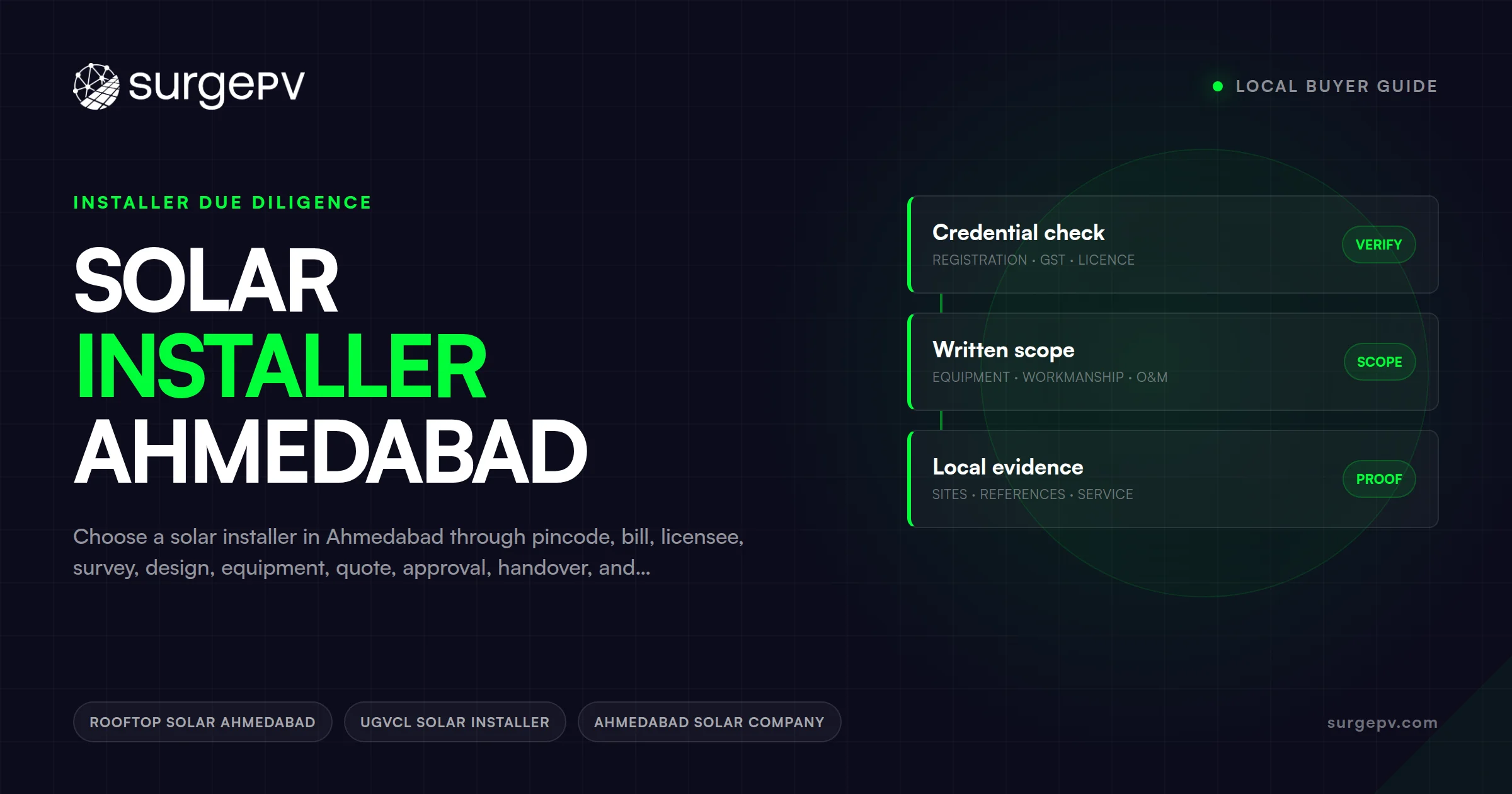
Choose a solar installer in Ahmedabad only after matching the exact pincode, latest electricity bill, legal consumer, category, connection, and distribution licensee. Then verify the company's entity, assigned team, local serviceability, survey, design, equipment, quote, approvals, contract, construction, commissioning, warranties, O&M, and exit evidence against the same written brief used for every bidder.
A solar installer in Ahmedabad should be selected for one address, connection, roof, and operating need. A citywide review score cannot prove fit for that project.
Ahmedabad has more than one possible electricity-licensee route. Start with the latest bill and exact pincode. Do not assign Torrent Power Ahmedabad or UGVCL from a neighbourhood name alone.
The buying method also changes across homes, societies, shops, offices, factories, captive projects, open access, and storage. Classify the route before requesting a final price.
Quick Answer
Choose a solar installer in Ahmedabad only after matching the exact pincode, latest electricity bill, legal consumer, category, connection, and distribution licensee. Then verify the company’s entity, assigned team, local serviceability, survey, design, equipment, quote, approvals, contract, construction, commissioning, warranties, O&M, and exit evidence against the same written brief used for every bidder.
This guide covers:
- Address, consumer, bill, pincode, and licensee verification
- Residential CFA, unsubsidised, society, C&I, captive, open-access, and storage routes
- Local entity, people, subcontractor, reference, and serviceability checks
- Ahmedabad roof, heat, dust, drainage, fire, access, and electrical evidence
- Exact equipment, design, yield, quote, contract, and payment controls
- Construction, EHS, commissioning, handover, warranty, and local service
- Related-party disclosure and SurgePV’s software boundary
Solar Installer Ahmedabad Route Card
Create a one-page route card before speaking to installers. It keeps sales assumptions from becoming project facts.
| Route-card field | Buyer-controlled evidence | Why it matters |
|---|---|---|
| Exact site | Address, pincode, map reference, premises, roof, and access | Separates local service and physical scope |
| Legal consumer | Bill name, service number, category, phase, load, meter, and billing history | Controls the application and electrical route |
| Distribution licensee | Current bill plus current utility confirmation | Controls forms, feasibility, meter, inspection, and commissioning interfaces |
| Property authority | Owner, tenant, society, landlord, lender, roof right, and consent | Establishes who may contract and alter the property |
| Project class | Residential, society, C&I, institutional, captive, open access, or storage | Changes eligibility, approvals, engineering, tax, and contract |
| Operating need | Self-use, export, zero export, backup, peak control, EV, or resilience | Changes design, controls, tests, and financial assumptions |
| Decision team | Technical, commercial, legal, safety, operations, and finance owners | Prevents one salesperson from defining the project |
Mark every field as verified, assumed, pending, or not applicable. Assign an owner and due date to each open item.
The route card should not include a promised subsidy, approval date, generation number, or payback. Those outputs need separate current evidence and defined assumptions.
Set evidence expiry dates
Local procurement evidence does not stay current forever. Give every time-sensitive item an owner, retrieval date, source, expiry trigger, and refresh date.
Refresh the bill and consumer record after a connection change. Refresh portal and vendor evidence before selection, installation, inspection, and CFA submission where applicable.
Recheck equipment records before purchase and delivery. Recheck licences, insurance, assigned people, subcontractors, and bank details before notice to proceed and payment.
Update the route after a design, capacity, ownership, category, meter, pincode, licensee, scheme, or utility-process change. Record which quote, drawing, application, programme, and contract term changed.
An archived screenshot can prove what the buyer reviewed on one date. It cannot establish current approval, eligibility, registration, or serviceability without fresh confirmation.
Verify the Exact Licensee From the Bill
The National Portal’s official DISCOM directory lists Torrent Power Limited Ahmedabad and UGVCL as distinct Gujarat entries. That list does not map your roof.
Read these fields from the latest bill:
- Legal distribution-licensee name
- Consumer and service number
- Consumer name and category
- Service address and pincode
- Phase and sanctioned load or contract demand
- Meter number and relevant billing identifiers
- Recent consumption and recorded demand where applicable
Confirm any mismatch before procurement. A changed owner, tenant, meter, category, load, or address may affect the application and contract sequence.
Torrent Power maintains an Ahmedabad Solar Guide with current utility information routes. Its page includes policy, document, meter, tariff-order, and open-access sections.
That page does not establish your feasibility or charge. Obtain the current project record from the applicable utility process.
The installer should write the named licensee in the quote, design basis, responsibility matrix, programme, and contract. “DISCOM approval included” is too vague.
Use pincode as a service test, not a legal shortcut
Pincode helps test travel, team allocation, logistics, and response. It does not replace the bill as evidence of the licensee.
Ask every bidder to confirm in writing:
- Whether it accepts the exact pincode
- Which legal entity will contract and invoice
- Which office or team will coordinate the project
- Which people will survey, supervise, commission, and service
- Which work will be subcontracted
- Expected travel, visit, access, freight, and service exclusions
- Escalation if the assigned person leaves
Verify the response with a named team and comparable references. A map pin, salesperson, or generic service-area page does not prove technical coverage.
Classify the Project Before Checking Vendors
Installer qualification depends on the project route. A residential portal vendor may not be suitable for a live factory or off-site transaction.
Eligible residential CFA route
Start at the current PM Surya Ghar National Portal. Verify the legal consumer, eligible category, licensee, vendor, system, equipment, DCR, feasibility, inspection, meter, bank, and application conditions.
Do not treat central financial assistance, called CFA, as a seller discount. The applicant should retain phone, email, password, OTP, bank details, and application records.
Do not publish or rely on an old CFA amount. Use the live official route and operative guidelines at the decision date.
The PM Surya Ghar installation guide explains the household process. The vendor-near-me guide focuses on portal discovery and real serviceability.
Unsubsidised residential route
A home may proceed outside CFA due to consumer, equipment, timing, design, or buyer choice. The system still needs the applicable utility, electrical, structural, safety, and contract review.
Do not let “no subsidy” become “no approval.” Define the connection, export, meter, inspection, and authority route with current evidence.
Housing society or group route
Identify the legal applicant and connection. A common-area meter, member connection, shared system, or multiple roofs can create different decisions.
Record society authority, resolution, voting rule, roof rights, allocation, access, future roof work, insurance, billing, maintenance, dispute, and exit provisions.
Do not assume an individual residential process applies to a common connection. Verify current scheme and utility treatment for the exact arrangement.
Commercial and industrial route
Start with load, contract demand, operating hours, shutdowns, roof or land rights, electrical network, fire rules, insurance, tax, and export conditions.
Residential CFA does not apply automatically to commercial or industrial connections. Keep the residential portal workflow outside the business quote unless an official rule supports it.
Use the commercial installer guide for business-building procurement. Use the industrial installer guide for live-factory interfaces.
Captive and open-access route
Off-site or captive projects need legal, ownership, consumption, connectivity, access, scheduling, metering, settlement, land, evacuation, and state-regulatory review.
Do not treat a rooftop installer registration as evidence for this route. Verify the developer, EPC, legal counterparty, grid team, project references, finance, and contracts separately.
GERC publishes current renewable-energy regulations and amendments. Read the instruments applicable to the exact route and date.
Storage or backup route
Define the intended service before sizing a battery. Backup, peak control, solar shifting, export management, and power-quality support require different designs.
List critical loads, peak power, energy duration, recharge, grid behaviour, generator interaction, transfer, protection, fire, location, temperature, ventilation, monitoring, and degradation assumptions.
Do not assume a grid-connected solar inverter supplies loads during an outage. Require the proposed operating sequence and tested protected-load boundary.
Keep This Page Distinct From Nearby Guides
This page owns address-level Ahmedabad installer procurement. It uses pincode, bill, licensee, site conditions, and local service evidence.
The Gujarat solar-company guide retains statewide route selection. The Gandhinagar solar-company guide retains its separate local market.
The India EPC guide owns national turnkey RFP and contract depth. Cost and financing pages retain price, savings, and transaction-model decisions.
This article does not list the best Ahmedabad companies. It gives every qualified bidder identical acceptance gates.
Build a Buyer Team and Evidence Folder
A homeowner may combine several roles. A society or business should name them separately where practical.
Assign responsibility for:
- Consumer, property, roof, and access decisions
- Utility, portal, meter, and authority coordination
- Structural, electrical, fire, and design review
- Commercial comparison, tax, finance, and payment
- Contract, insurance, privacy, and dispute review
- Construction access, EHS, quality, and shutdowns
- Commissioning, handover, warranty, and service acceptance
Create one controlled folder before seeking bids. Separate identity, bill, property, survey, design, equipment, quote, contract, approvals, construction, tests, handover, and service.
Name files by project, document, revision, status, and date. Keep superseded records without letting them direct construction.
Use a decision register:
| Field | Required record |
|---|---|
| Issue | Exact requirement, conflict, or missing evidence |
| Source | Bill, survey, regulation, utility record, design, quote, or contract |
| Owner | Buyer, installer, reviewer, utility, authority, OEM, or other party |
| Status | Open, answered, approved, rejected, changed, or superseded |
| Effect | Safety, eligibility, design, price, programme, warranty, or service |
| Decision | Approver, date, reason, condition, and updated documents |
Keep phone promises out of the final basis. Confirm material statements through written clarification and signed contract documents.
Verify the Company Behind the Salesperson
Match the legal entity across quotation, tax record, portal profile where applicable, bank beneficiary, invoice, insurance, workmanship warranty, and contract.
Resolve trade names and group companies before payment. An affiliate’s licence, project, staff member, or financial record does not automatically belong to the bidder.
Request current evidence for:
- Legal constitution, address, registrations, and authorized signatory
- Tax identity and bank beneficiary
- Applicable electrical-contractor licence and responsible people
- Insurance and subcontractor coverage
- Named project, engineering, EHS, quality, commissioning, and service teams
- Comparable references and permission to contact owners
- Current workload, material commitments, and delivery capacity
- Complaint, escalation, warranty, and continuity process
Gujarat’s Chief Electrical Inspector explains its electrical-law and inspection functions. Exact inspection duties depend on the installation and jurisdiction.
CEICED also provides electrical-installation and contractor-licence checklists. A checklist or licence does not prove design quality, safe delivery, finance, or service.
Verify every subcontractor
Ask who performs survey, structural review, electrical design, procurement, roof work, installation, testing, portal support, and service.
For each subcontractor, record legal entity, role, people, competence, supervision, insurance, access, confidentiality, payment, replacement, and accountability.
The prime installer should remain responsible for contracted work. A subcontractor relationship should not create an owner coordination gap.
Interview the people assigned to the project. Ask them to explain the proposed site, risks, survey plan, review steps, and service route.
Check comparable references
Match references by pincode or travel area, consumer type, licensee, roof, capacity band, electrical connection, equipment, project route, and completion date.
Contact the owner through independently verified details. Ask about survey errors, substitutions, changes, leaks, trips, monitoring, documents, warranty claims, and response.
Visit one completed site when permission and safety allow. Appearance cannot prove hidden structural or electrical quality, but it can expose access and documentation issues.
Test Actual Ahmedabad Serviceability
Local service is a system, not a claim. Ask who receives the ticket, diagnoses remotely, attends the site, carries spares, coordinates OEM claims, and closes records.
Request:
- Named service owner and backup
- Current contact channel and ticket number process
- Covered hours and priority classes
- Remote-response and site-visit definitions
- Pincode, travel, access, and charge exclusions
- Installer-held and owner-held spare strategy
- OEM escalation and replacement process
- Complaint escalation and unresolved-case governance
- Continuity if a technician, subcontractor, or OEM changes
Open a sample ticket before award. Test whether the bidder can identify the account, route the issue, provide a reference number, and explain escalation.
Ask for one redacted service example from a comparable project. Verify the initial report, diagnosis, attendance, parts, correction, test, owner communication, and closure.
Do not convert one successful test into a guarantee. Put required service levels, exclusions, evidence, credits, and termination rights into the contract.
Audit the Ahmedabad Roof and Site
The survey should be performed by named competent people using recorded methods. A sales photograph is not a measured site pack.
Roof geometry and condition
Record dimensions, levels, slopes, parapets, tanks, stair cabins, lift rooms, vents, antennas, services, neighbouring buildings, trees, and future obstructions.
Identify RCC slab, metal sheet, standing seam, tile, canopy, carport, or mixed construction. Record age, condition, repairs, distress, corrosion, fasteners, joints, and available drawings.
The structural scope should define investigation, loads, load paths, attachment, ballast, uplift, local effects, material compatibility, strengthening, and professional responsibility.
A visual statement that the roof is strong is insufficient. Elevated structures, older buildings, long spans, distress, or missing records need qualified review.
Waterproofing and monsoon drainage
Photograph the roof before work. Record cracks, damp areas, membranes, coatings, repairs, outlets, slopes, ponding, and warranty conditions.
The design should preserve drains and flow paths. Foundations, conduits, cable loops, and walkways should not trap water or block cleaning.
Define whether penetrations are permitted. State preparation, flashing, sealant, cure, inspection, water testing, defect responsibility, and warranty interaction.
Do not make the installer responsible for every pre-existing leak. Do not exclude every later leak either. Use baseline evidence and a clear causation process.
Heat and equipment location
Ahmedabad heat requires site-specific thermal review. Record solar exposure, ventilation, wall or rooftop temperature, shading, clearance, dust, water, and service access.
Place inverters and batteries within their exact manufacturer requirements. Do not enclose equipment without checking heat rejection and maintenance.
Generation modelling should state temperature inputs and loss treatment. Equipment warranty and output can depend on operating conditions.
Dust, cleaning, and access
Document nearby roads, construction, industrial activity, birds, vegetation, and cleaning-water conditions. These observations inform maintenance assumptions without creating a fixed soiling claim.
Provide safe access to module rows, drains, isolators, inverters, meters, fire routes, and roof equipment. Avoid layouts that maximize module count but prevent maintenance.
Define cleaning method, access system, water, worker safety, schedule basis, records, and exclusions. Check whether hard water or chemicals create manufacturer concerns.
Fire, heritage, airport, and building interfaces
Identify occupancy, building height, fire systems, emergency routes, responder access, hazardous areas, and existing approvals. Coordinate the design with current site obligations.
Ahmedabad Municipal Corporation provides current municipal and fire-service routes. Applicability depends on the exact property and proposed work.
Do not assume every rooftop needs the same municipal or fire action. Verify building, heritage, airport, development, fire, and other interfaces with qualified reviewers.
Audit the Electrical Point of Common Coupling
The point of common coupling, called PCC, defines where the solar system interacts with the customer and utility network. Record it before final equipment selection.
The survey should capture:
- Service voltage, phase, sanctioned load, and contract demand
- Meter, current transformers, and billing arrangement where applicable
- Main board, bus rating, breaker, conductor, transformer, and spare capacity
- Fault level and protection duties where study is required
- Existing earthing, lightning, surge, and isolation arrangements
- Generator, UPS, capacitor bank, drive, charger, and sensitive-load interactions
- Utility export, zero-export, meter, protection, and communication requirements
- Shutdown windows, isolation authority, temporary supply, and restoration tests
Trace the proposed connection from inverter to PCC. Draw cable route, isolation, protection, metering, and ownership boundaries.
Do not size a system from sanctioned load alone. Review actual load, operating schedule, future change, export rules, and technical feasibility.
Export and zero-export controls
Define whether export is permitted, limited, or prohibited. State the control method, measurement point, fail-safe behaviour, communication dependency, and test procedure.
A zero-export setting is not self-proving. Test meter direction, current-transformer polarity, controller response, communication loss, inverter coordination, and recovery.
Do not promise utility acceptance from a controller datasheet. Use the current licensee process and project test requirements.
Power quality and protection
Larger or sensitive sites may need studies for voltage, harmonics, flicker, reactive power, fault level, protection coordination, and anti-islanding.
Define who performs each study, which data is used, who reviews it, and what settings are controlled. Preserve approved files and final settings.
The project should not rely on default inverter settings without checking the current grid and utility basis. Restrict settings access after commissioning.
Generator and backup interactions
Document generator controls, changeover, synchronization, protected loads, interlocks, and operating modes. Prevent unintended backfeed or unstable parallel operation.
For storage, define grid-connected and outage sequences. Test transfer, recharge, state-of-charge limits, alarms, manual bypass, shutdown, and emergency operation.
Use the residential battery sizing guide for load and duration decisions. Final design still needs site, equipment, and electrical review.
Freeze the Survey and Design Basis
Require a dated survey report with surveyor, instruments, photographs, measurements, assumptions, limits, and unresolved requests for information.
The design basis should state:
- Site, consumer, licensee, project route, capacity, and energy boundary
- Roof or land geometry, structure, drainage, access, fire, and environmental conditions
- Exact modules, inverters, storage, structures, meters, protection, and monitoring
- Layout, orientation, tilt, shading, strings, MPPT allocation, and cable routes
- PCC, export, protection, earthing, lightning, communication, and operating modes
- Weather, temperature, dust, losses, availability, degradation, and uncertainty treatment
- Applicable standards, utility criteria, approval assumptions, and document hierarchy
- Design stages, reviews, hold points, substitutions, changes, and as-built requirements
Issue documents by project, revision, status, preparer, checker, approver, and permitted use. Feasibility drawings should not direct construction.
Run cross-document QA. Match address, consumer, capacity, equipment, quantities, strings, routes, protection, forms, quote, model, and contract.
Use a solar designing platform to align geometry, layout, strings, and bill of materials. Software does not verify the roof or approve the design.
A shadow analysis should model measured obstructions. It should not use one unexplained shade percentage for every Ahmedabad roof.
Review Yield and Financial Assumptions
Ask every bidder to use one owner-approved comparison basis. Different weather, shade, heat, dust, loss, self-use, export, tariff, and downtime inputs can distort ranking.
The yield record should identify:
- Weather source, location, period, version, and access date
- Geometry, horizon, orientation, tilt, and shade model
- Module, inverter, strings, DC-to-AC ratio, and clipping
- Temperature, soiling, mismatch, wiring, transformer, and auxiliary losses
- Availability, grid outage, curtailment, export control, and maintenance
- Degradation convention, operating horizon, uncertainty, and scenarios
Do not accept a universal units-per-kilowatt promise. Actual weather, obstruction, temperature, condition, operation, outages, cleaning, and equipment affect output.
Savings need interval load, tariff, self-use, export treatment, charges, tax, finance, maintenance, replacement, and degradation assumptions. Keep residential and business models separate.
Use the generation and financial tool to compare common inputs. It does not guarantee generation, savings, payback, tariff, or approval.
Any contractual performance undertaking needs metric, boundary, period, data, weather adjustment, exclusions, tolerance, test, correction, and remedy.
Verify Exact Equipment and Traceability
Require manufacturer, full model, rating, quantity, revision, warranty, registration, and approved-alternative status before order.
Cover modules, inverters, batteries, structures, cables, connectors, isolators, surge protection, overcurrent devices, meters, loggers, sensors, communication devices, and accessories.
MNRE publishes current ALMM lists and clarifications. Determine applicability and DCR conditions from the exact project route and operative documents.
BIS lists solar-product categories under its compulsory registration scheme. Verify the exact model, applicant, standard, status, and date.
Neither portal qualifies the installer. Keep product, person, contractor, and project evidence separate.
Control substitutions
Require prior written approval before purchasing or installing an alternative. Compare technical, compliance, physical, electrical, communication, energy, warranty, service, schedule, and price effects.
Update layout, strings, structure, calculations, protection, monitoring, authority documents, quote, warranties, tests, and as-built records wherever affected.
An unapproved substitution is a defect. Define removal, replacement, retest, cost, and delay responsibility.
Preserve serial and batch records
At delivery, reconcile approved schedule, purchase record, packing list, model, quantity, serial or batch, condition, warranty, and registration.
Quarantine damaged, mismatched, or unapproved items. Do not install material while a technical or commercial discrepancy remains open.
The final asset register should connect each installed item to its location, serial, warranty, test, owner, and claim route.
Issue One Comparable Ahmedabad Solar RFQ
Give qualified bidders one request for quotation, called an RFQ. Include the same bill, site pack, route card, requirements, contract, and response schedules.
The RFQ should cover:
- Legal consumer, property, licensee, pincode, and project route
- Survey, investigation, design, and owner-input boundaries
- Exact equipment, quantities, alternatives, and traceability
- Roof, structure, waterproofing, drainage, access, and fire work
- Electrical PCC, protection, export, meter, monitoring, and shutdowns
- Utility, portal, inspection, municipal, and other authority responsibilities
- Construction, EHS, quality, supervision, and subcontractors
- Programme, dependencies, changes, delays, and owner actions
- Tests, commissioning, handover, training, defects, and acceptance
- Warranties, O&M, service, spares, data, escalation, and exit
- Price, tax, freight, access, allowances, exclusions, payment, and security
Require clause-by-clause compliance. Each exclusion, qualification, allowance, provisional amount, and alternative needs a precise reference.
Issue material clarifications to all bidders. Freeze the final technical and commercial offer before evaluation.
Normalize Quotes and Total Cost
Do not compare headline price until the same work and risk are included. Create a normalization schedule beside every bid.
| Quote block | Normalize these items |
|---|---|
| Capacity | Module DC, inverter AC, storage power and energy, auxiliaries, and connection boundary |
| Equipment | Exact models, quantities, accessories, registration, warranty, spares, and alternatives |
| Roof and civil | Survey, review, structure, strengthening, waterproofing, drainage, lifting, access, and reinstatement |
| Electrical | PCC work, cables, routes, panels, protection, earthing, lightning, meter, communication, and shutdowns |
| Approvals | Applications, drawings, studies, fees, signatures, inspections, witnesses, meter, and corrections |
| Delivery | Freight, unloading, storage, security, supervision, EHS, quality, testing, and documents |
| Lifecycle | Monitoring, licences, O&M, cleaning, travel, spares, warranty labour, replacements, data, and exit |
| Commercial | Tax, currency, escalation, payment timing, security, insurance, changes, delay, and remedies |
Show each adjustment separately. An owner estimate is not the bidder’s committed price.
Do not invent a local price per kilowatt. Roof, access, connection, equipment, approvals, risk, and service can make two Ahmedabad projects incomparable.
Total cost should include buyer time, authority work, monitoring, licences, maintenance, cleaning, spares, replacements, warranty handling, and transition where relevant.
Use the commercial rooftop cost guide for deeper scope-based costing. Keep residential and industrial tax treatment with qualified advisers.
Contract Responsibilities and Payment
The contract should identify the exact entity, documents, scope, hierarchy, standards date, design duty, equipment, programme, price, tax, and acceptance method.
Use a responsibility matrix for every owner, installer, subcontractor, utility, authority, OEM, insurer, and other party action.
Define who prepares, reviews, signs, submits, pays, attends, answers, corrects, and stores each approval record. Avoid “all approvals included.”
Tie payment to evidence
Payment stages may follow approved design, verified equipment, inspected delivery, completed work, passed tests, utility prerequisites, commissioning, defect closure, and handover.
Do not release final payment because modules are visible or an inverter turns on. Require the contracted test and document set.
Address advances, security, retention, title, off-site material, insurance, withholding, disputed amounts, and insolvency with advisers.
Govern change and delay
Define changes to scope, basis, equipment, quantity, route, sequence, date, law, utility requirement, and owner input.
A change notice should state cause, responsibility, mitigation, technical effect, safety effect, price, programme, approval effect, and document updates.
Separate provider-controlled delay, owner delay, authority delay, and force majeure through evidence. No installer can guarantee a utility or authority decision.
Define defects and termination
Classify safety, functional, performance, roof, documentation, and cosmetic defects. State containment, correction, retest, access, due date, owner correction, and cost recovery.
Cover termination, safe demobilization, title, equipment, subcontractors, warranties, documents, designs, data, credentials, payments, and transition.
The buyer should be able to appoint another qualified provider without losing the project record or monitoring access.
Control Construction, EHS, and Quality
Require a project plan before mobilization. It should cover people, work sequence, access, lifting, storage, temporary works, weather, EHS, quality, housekeeping, and emergency response.
EHS should address work at height, fragile roofs, edge protection, rescue, falling objects, lifting, electrical isolation, hot work, heat, dust, weather, chemicals, traffic, and public interfaces.
For operating sites, add production, process, contamination, hazardous-area, shutdown, security, and emergency coordination.
The owner should define site rules and stop-work authority. Owner review does not remove installer responsibility.
Inspect roof work
Record the roof condition before loading or drilling. Mark permitted storage, access, attachment, and exclusion zones.
Inspect structure grade, section, coating, fasteners, attachment, ballast, alignment, clearance, and corrosion interfaces against approved documents.
Photograph concealed work before covering it. Record waterproofing preparation, penetration, flashing, sealant, cure, and inspection.
Keep drains and maintenance paths open. Close sharp-edge, unsupported-cable, loose-fastener, corrosion, and trip hazards before electrical work.
Inspect electrical work
Check cable identity, route, support, bend, separation, connector compatibility, glands, termination, isolation, surge protection, overcurrent protection, labels, earthing, and equipment settings.
Use an approved inspection and test plan. Each activity needs acceptance criteria, record, witness, hold point, and release authority.
Control drawings by revision and status. Field changes need engineering review before concealment or energization.
Record nonconformance, containment, cause, correction, disposition, verification, and closure. Informal acceptance should not replace evidence.
Assign Every Approval and Utility Interface
Build a project register from current sources. Include route, authority, applicability, responsible person, input, submission, fee, inspection, query, condition, approval, validity, and record.
GERC’s current regulations index includes rooftop net-metering instruments and amendments. Its draft-regulations index also lists 2026 proposals.
Drafts are not operative requirements. Track them as potential change only after qualified review.
The applicable licensee process can include application, feasibility, drawings, meter, inspection, agreement, commissioning, correction, and grievance steps. Verify the live route.
CEICED, AMC, fire, building, heritage, airport, environmental, factory, labour, insurer, and lender interfaces may apply. Do not add or omit them by assumption.
No installer controls third-party approval. It can accept duties for complete documents, competent coordination, timely response, notice, and correction within its control.
Protect consumer credentials and bank data. Record every submission, acknowledgement, query, payment, inspection, condition, and final document.
Commission Against Written Tests
Commissioning starts with approved drawings, exact equipment, safe readiness, utility prerequisites, calibrated instruments, and named witnesses.
The test plan should cover as applicable:
- Visual condition, access, structure, roof, drainage, routes, labels, and housekeeping
- Module and string identity, polarity, continuity, voltage, and current checks
- Insulation, conductor termination, isolation, surge protection, grounding, and earthing
- Inverter identity, firmware, settings, grid response, MPPT allocation, alarms, and restart
- PCC, protection, meter, current transformer, ratio, direction, time, import, and export
- Communication, monitoring, owner account, alerts, reports, data export, and backups
- Zero-export, generator, battery, transfer, protected-load, BMS, and outage functions
- Shutdown, safe isolation, emergency instructions, training, and restoration
For every test, record method, condition, instrument, calibration, result, limit, witness, date, defect, correction, and retest.
Authority inspection and owner acceptance are different gates. Passing one does not prove every contract requirement.
Do not waive an out-of-limit result verbally. Place the system in a safe state, correct it, and preserve the retest record.
Define acceptance stages
Separate mechanical completion, ready for energization, commissioning completion, provisional acceptance, operational acceptance, and final acceptance where needed.
Each stage should list prerequisites, permitted open items, signatory, payment effect, warranty start, risk transfer, and restriction.
Safety, grid, functional, or major document defects should block acceptance. Classify minor punch items and set closure dates.
Accept a Complete Handover
Create the handover index before construction. Populate it during the project instead of rebuilding it after final payment.
Require as applicable:
- Contract, approved changes, invoices, receipts, tax documents, and payment ledger
- Approved and as-built layout, single-line diagram, string schedule, routes, and details
- Design basis, calculations, studies, energy model, assumptions, and review records
- Equipment schedule, serials, batches, datasheets, registrations, and inspection records
- Construction quality records, concealed-work photographs, nonconformance, and defect closure
- Test methods, instrument records, raw data, results, settings, and witnesses
- Portal, utility, inspectorate, municipal, fire, insurer, and other authority records
- Manufacturer warranties, installer warranties, registrations, claim routes, and contacts
- O&M plans, cleaning, shutdown, emergency, fault, escalation, spares, and training
- Monitoring owner account, administrator transfer, alerts, data export, licences, and backups
Test buyer access. The owner should log in, receive alerts, export records, locate current drawings, and follow safe shutdown instructions.
Remove provider access that is no longer required. Keep controlled role access where service duties continue.
Reconcile the physical system with drawings, equipment, serials, settings, monitoring tags, warranties, and spares before acceptance.
Separate Warranties, O&M, and Insurance
One long module term is not a whole-system warranty. Build a responsibility matrix by component, failure, provider, term, start, exclusions, and remedy.
Separate:
- EPC or design responsibility
- Installer workmanship and defect liability
- Roof and waterproofing responsibility
- Module product and performance terms
- Inverter, battery, structure, and other OEM terms
- Any measured plant-performance remedy
- Monitoring and communication service
- O&M, cleaning, response, spares, and reporting
- Owner and contractor insurance responsibilities
For each claim, identify notice, evidence, remote diagnosis, attendance, labour, travel, freight, removal, replacement, reinstallation, tax, testing, and escalation.
Define maintenance needed to preserve warranties. Keep records of cleaning, inspections, settings, alarms, repairs, and unauthorized changes.
An OEM replacement may not cover installer labour or access. The contract should close that gap or make the owner’s exposure visible.
Define service survival after installer termination. Assign warranties, transfer accounts, release records, and cooperate with a replacement provider.
Use a Controlled Pilot for Repeat Buying
A homeowner usually buys one site. A society, developer, landlord, business group, or channel may plan several roofs. Use a representative pilot before a broad award.
Choose a site with normal constraints, not only the easiest roof. Define pilot success before work begins.
Useful pilot metrics include:
- Route and licensee screening accuracy
- Survey completeness and unresolved-information rate
- Design defects, assumptions, and cross-document mismatches
- Quote deviations, substitutions, and change frequency
- Provider-controlled schedule and owner review effort
- EHS, quality, test, document, and defect performance
- Monitoring, training, service ticket, escalation, and archive usability
Separate owner, utility, authority, provider, and force-majeure effects. Do not move the metric after seeing results.
Use pilot evidence to update the RFQ, contract, templates, training, acceptance, and rollout capacity. A successful pilot does not remove later site verification.
Ahmedabad Installer Red Flags
Stop and clarify when a bidder:
- Assigns Torrent Power or UGVCL without reading the current bill
- Claims CFA for every connection or presents it as guaranteed discount
- Asks to control the permanent portal account, OTP, or bank record
- Provides a final quote before measuring roof and electrical conditions
- Hides the legal entity, payee, subcontractors, or assigned people
- Refuses current, comparable, independently contactable references
- Withholds exact module, inverter, battery, or protection models
- Promises fixed generation or savings without a documented model
- Ignores heat, dust, drainage, waterproofing, fire, or maintenance access
- Says all electrical and approval work is included without a schedule
- Requires most payment before tests, records, and handover
- Combines every warranty into one headline term
- Cannot explain local ticket, visit, spare, OEM, and escalation routes
- Blocks owner access to monitoring, settings records, or project files
A red flag is a request for evidence, not automatic proof of misconduct. Record the answer and decision.
Heaven Green Energy Disclosure and Equal Gates
Disclosure: SurgePV and Heaven Green Energy have a related commercial relationship. Heaven Green is not ranked or presented as Ahmedabad’s best installer.
Heaven Green Energy
presents solar services on its own website. That first-party page does not prove current pincode coverage or project fit.
If Heaven Green is considered, verify the exact contracting entity, tax record, payee, licence, portal mapping where applicable, named team, subcontractors, insurance, and references.
Give it the same bill, site pack, RFQ, design basis, equipment schedule, contract, and acceptance method as every other qualified bidder.
Normalize its survey, scope, price, tax, exclusions, approvals, programme, payment, safety, testing, warranties, O&M, local response, and exit.
Do not infer office location, Ahmedabad capacity, manufacturer authority, vendor status, results, schedule, or service from the related-party relationship. Obtain current written evidence.
The same pass or fail gates apply. Choose another bidder when its controlled evidence and contract are stronger.
SurgePV Has a Software Boundary
SurgePV can support design, shade, generation, financial, and proposal workflows. It is not the installer, surveyor, structural reviewer, designer of record, electrical contractor, inspector, licensee, regulator, adviser, or guarantor.
Software geometry does not prove roof dimensions or condition. A digital layout does not approve structure, waterproofing, fire access, or utility connection.
Simulation outputs remain estimates based on inputs. They do not guarantee generation, savings, payback, tariff, approval, or service.
The installer remains responsible for contracted work. The owner and appointed reviewers remain responsible for their decisions.
Final Ahmedabad Buyer Checklist
Do not issue notice to proceed until every applicable gate has a current record.
Address and route
- Exact address and pincode verified
- Bill, consumer, category, phase, load, meter, and licensee verified
- Residential, society, C&I, captive, open-access, or storage route classified
- Property, roof, access, applicant, and consent authority confirmed
Installer and serviceability
- Legal entity, tax identity, payee, signatory, licence, and insurance checked
- Named design, site, EHS, quality, commissioning, and service people confirmed
- Subcontractors disclosed and governed
- Comparable references checked independently
- Pincode response, travel, visit, spares, OEM, and escalation tested
Survey and design
- Roof, structure, waterproofing, drainage, shade, heat, dust, access, and fire recorded
- PCC, phase, load, meter, protection, export, power quality, generator, and shutdown recorded
- Exact design basis, model, assumptions, reviews, changes, and as-built duties approved
- Yield and financial assumptions normalized and sensitivity-tested
Equipment and quote
- Exact models, quantities, registrations, warranties, and serial controls fixed
- Substitution requires prior written comparison and approval
- One RFQ used for every bidder
- Price, tax, freight, access, approvals, lifecycle cost, and exclusions normalized
Contract and delivery
- Responsibilities, hierarchy, programme, payment, security, changes, delays, defects, and termination written
- Construction, EHS, quality, inspections, nonconformances, and field changes controlled
- Portal, utility, inspectorate, municipal, fire, and other applicable actions assigned
- No third-party approval or outcome is guaranteed
Acceptance and service
- Written tests, instruments, conditions, witnesses, raw data, and retests approved
- Handover index, owner accounts, training, spares, and records complete
- Product, workmanship, roof, performance, monitoring, O&M, and insurance duties separated
- Local response, claims, escalation, data export, transition, and exit tested
Refresh every scheme, licensee, regulation, utility, bidder, person, model, price, approval, warranty, and service observation before contract and commissioning.
Frequently Asked Questions
How should I choose a solar installer in Ahmedabad?
Verify the pincode, latest bill, legal consumer, category, connection, and licensee first. Then compare the legal entity, assigned team, survey, design, exact equipment, approvals, quote, contract, construction, tests, handover, warranties, and local service through one written brief.
Is every Ahmedabad property served by Torrent Power?
Do not assume it. Official records list Torrent Power Limited Ahmedabad and UGVCL as distinct Gujarat licensees. Read the exact legal licensee, service number, category, phase, sanctioned load, meter, and address from the latest bill, then confirm the route.
Can an Ahmedabad homeowner receive PM Surya Ghar CFA?
An eligible residential consumer may use the current official process. Verify the live scheme, consumer, vendor, system, equipment, DCR, inspection, meter, bank, and portal conditions before ordering. Do not treat CFA as a guaranteed seller discount.
Do housing societies follow the same residential solar route?
Not automatically. Verify the applicant, connection, consumer category, society authority, roof rights, member approvals, beneficiary, and system structure. Also check the current scheme, metering, tax, maintenance, billing, insurance, and exit duties.
What should an Ahmedabad rooftop solar survey include?
Measure roof geometry, condition, structure, waterproofing, drainage, shade, heat, dust, access, fire routes, equipment locations, and cable routes. Also record the PCC, phase, sanctioned load, meter, panels, protection, earthing, communication, generators, and future loads.
How should I compare Ahmedabad solar quotations?
Issue one common RFQ and compare exact quantities, models, tax, freight, roof work, protection, monitoring, approvals, civil work, and access. Also compare tests, documents, warranty labour, local service, exclusions, payment milestones, and lifecycle cost.
Can an installer guarantee solar generation or savings?
No universal promise is reliable. Require a transparent model with measured geometry, weather source, shade, heat, dust, losses, uncertainty, degradation, downtime, self-use, export, tariff, and sensitivity. Any contractual undertaking needs a defined measurement and remedy method.
Which solar warranties and service duties should be separate?
Separate module, inverter, battery, structure, other OEM, installer workmanship, roof or waterproofing, any performance remedy, monitoring, O&M, and insurance duties. Record provider, term, exclusions, labour, travel, freight, response, claim, escalation, and exit.
How should I evaluate Heaven Green Energy in Ahmedabad?
Treat Heaven Green as one related-party candidate, not a ranked recommendation. Apply the same entity, pincode, team, reference, survey, design, equipment, price, contract, safety, commissioning, warranty, local-service, pilot, and exit gates used for every bidder.