

Quick Answer
Heat pump installations hit record levels across the UK, Germany, and the US in 2024 and 2025, driven by electrification mandates and rising gas prices. In the UK, Germany, and most of the northern US, January PV yield is roughly 10–15% of July yield on a per-kWp basis. A heat pump in the same location may need 4–6 times more electricity in January than in July.
Solar installers and EPC engineers face a specific design problem when a client wants to heat their home with both a heat pump and rooftop solar: the load profile and the generation profile are almost perfectly misaligned. PV generation peaks in June and July between 10:00 and 14:00. Heat pump demand peaks in December and January between 17:00 and 22:00. Naive annual-kWh matching — “the array produces as much as the heat pump consumes” — gives a number that looks good on paper but underdelivers in practice, because the surplus energy arrives at the wrong time of day and the wrong time of year.
Heat pump installations hit record levels across the UK, Germany, and the US in 2024 and 2025, driven by electrification mandates and rising gas prices. In the UK, Germany, and most of the northern US, January PV yield is roughly 10–15% of July yield on a per-kWp basis. Also see: Germany solar subsidies. Read more about Battery Solar System Design UK. For United Kingdom-specific compliance details, see United Kingdom comparisons/mcs-vs-non-mcs.
This mismatch is not a niche concern. Heat pump installations hit record levels across the UK, Germany, and the US in 2024 and 2025, driven by electrification mandates and rising gas prices. Many of those homeowners and businesses also want solar. The question for every designer is not whether to combine them but how to size and control the combination correctly — so that self-consumption stays high, grid import stays low, and the financial case holds up for the homeowner. Read more about Community Solar Projects Germany.
This guide covers everything required to do that: how to calculate heat pump electricity demand from first principles, how to translate demand into PV array size, how to choose between battery and thermal storage, and how SG Ready control changes the economics. We also point out the seven sizing mistakes that show up repeatedly in the field, and explain how a cloud-based solar design software tool can model the combined system in a single workflow.
TL;DR
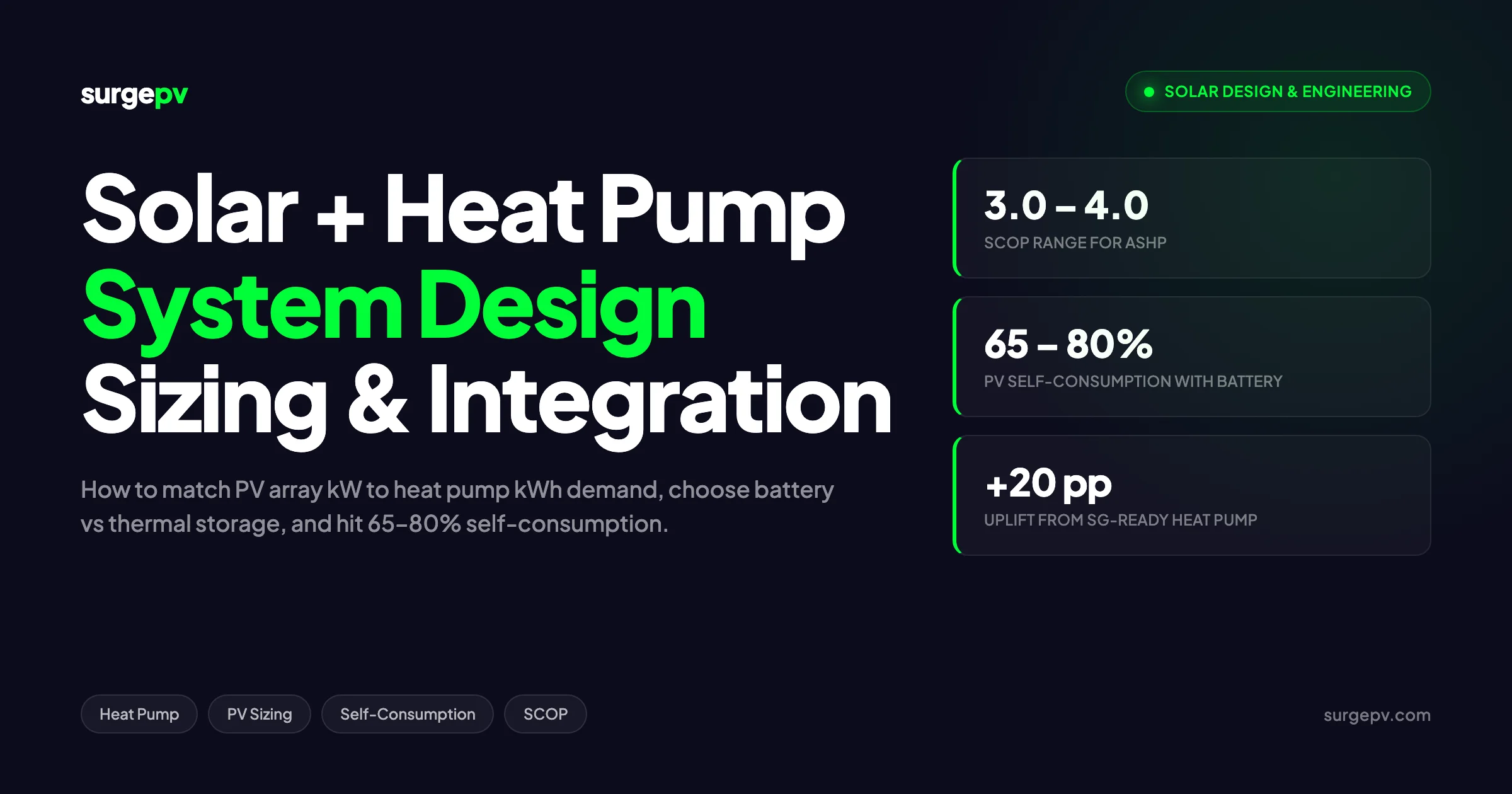
Self-consumption rates of 65–80% are realistic when pairing PV with battery storage and an SG-Ready heat pump (Velasolaris, 2024). The central design challenge is the load profile mismatch — PV peaks in summer midday while heat pump demand peaks in winter evenings. Correct sizing starts with heat demand, not PV capacity, and the right storage strategy depends on your tariff as much as your roof size.
For more on this topic, see Adding Battery Storage Services.
In this guide:
- Why solar + heat pump is an engineering problem, not just an equipment pairing
- How to calculate heat pump annual electricity demand by home type and climate
- SCOP, COP, and SPF — which number to use and why it matters
- Step-by-step sizing from building heat demand to PV array kWp
- Battery versus thermal storage — when each makes sense
- SG Ready control, diversion logic, and time-of-use tariff integration
- The seven most common sizing and integration mistakes
Why Solar + Heat Pump Pairing Is Engineering, Not Just Add-On
The simplest version of this design decision goes: “The heat pump uses X kWh per year; the array should produce X kWh per year.” That logic works for annual billing estimates. It does not work for self-consumption optimization, and it does not account for the two dimensions of load-generation mismatch that define these systems.
Daily mismatch. A heat pump running in space-heating mode typically draws most of its energy in the morning and evening — before and after peak solar generation. During a clear summer day, the PV array may generate well above household demand from 09:00 to 16:00, while the heat pump is barely running because the building is already warm. That midday surplus either exports to the grid at a low feed-in rate or goes to waste if there is no export tariff. Without storage or load-shifting, a significant fraction of the PV energy never meets the heat pump demand at all.
Seasonal mismatch. This is the harder problem. In the UK, Germany, and most of the northern US, January PV yield is roughly 10–15% of July yield on a per-kWp basis. A heat pump in the same location may need 4–6 times more electricity in January than in July. The result is that for three or four winter months, the PV array contributes almost nothing to heat pump supply, and for three or four summer months, it generates far more electricity than the heat pump needs.
Two design philosophies respond to this reality differently. The self-consumption-maximizing design accepts that it cannot solve the winter gap and instead focuses on capturing as much summer and shoulder-season generation as possible through a buffer tank, a battery, or both. The target is 65–80% annual self-consumption ratio. The export-friendly design deliberately oversizes the PV array to maximize annual export revenue under a favorable feed-in tariff, accepting lower self-consumption in exchange for higher grid revenue. Which approach makes sense depends on the local tariff structure more than any technical factor.
Our view is that in most residential markets with modest export tariffs — the UK’s Smart Export Guarantee, Germany’s Einspeisevergütung at current rates, or net billing arrangements in the US — the self-consumption path produces better 10-year economics for the homeowner. Export tariffs have fallen significantly since 2020 and show no sign of recovering to the levels that made pure export optimization attractive.
A designer who treats this as an equipment compatibility question and skips the load-profile analysis will size the array to the wrong target, place the battery at the wrong capacity, and leave the homeowner with a self-consumption ratio of 35–45% instead of the 65–80% that a well-designed system can achieve. Getting this right requires starting from the building’s actual heat demand.
Heat Pump Electricity Demand: How Many kWh Per Year
Before sizing any PV array, a designer needs a reliable figure for annual heat pump electricity consumption. That figure is not the heat pump’s rated power in kW — it is the annual kWh of electricity the heat pump will draw from the grid (and, in the target system, from the PV array). The two most reliable sources are the building’s Energy Performance Certificate (EPC) or heat loss calculation, combined with the heat pump’s SCOP.
The table below shows typical ranges drawn from published sources. These are consumption figures, not heat output figures.
| Home Type | Climate | System Type | Annual HP Electricity (kWh/year) | Source |
|---|---|---|---|---|
| Well-insulated new build, underfloor heating | UK / northern Europe | ASHP | 2,000–3,000 | Sunsave UK, 2026 |
| Average semi-detached, mixed radiators | UK | ASHP | 3,000–3,500 | Sunsave UK, 2026; Aira |
| Older detached, conventional radiators | Germany | ASHP | 5,000–8,000 | WOLF Germany |
| Well-insulated new build, underfloor heating | Spain / southern Europe | ASHP | 1,200–2,000 | Aurum Europe |
| Average semi-detached, mixed radiators | UK | GSHP | 2,100–2,500 | Sunsave UK, 2026 |
| Older detached, conventional radiators | Germany | GSHP | 3,500–5,600 | WOLF Germany |
Ground-source heat pumps consume approximately 25–30% less electricity than air-source equivalents for the same heat output, because their SCOP is higher — a point we return to in the next section. The GSHP advantage is most pronounced in cold climates where ASHP performance degrades significantly at low ambient temperatures.
Two figures are regularly confused in this context:
SCOP (Seasonal Coefficient of Performance) is a lab-derived, standardized metric calculated under EN 14825 test conditions. It represents annual average performance across a reference climate bin set. Manufacturers publish SCOP on product datasheets, and it is used in EU energy labeling. It is the correct input for sizing calculations.
SPF (Seasonal Performance Factor) is the field-measured ratio of heat delivered to electricity consumed over an actual operating season. SPF is always site-specific and almost always lower than SCOP, because it includes defrost cycles, pump parasitic loads, and the effect of non-optimal control. The gap between SCOP and SPF is typically 0.3–0.8 in northern European field studies. When building a financial model for a client, use SCOP for the initial sizing and then apply a 10–15% SPF derate to the annual savings projection to stay conservative. For Europe-specific compliance details, see Europe solar compliance.
Pro Tip
If the home does not have an EPC, you can estimate heat demand using the simplified rule of 100 W/m² for a poorly insulated older home, 50 W/m² for an average home, and 25–30 W/m² for a well-insulated new build. Multiply by the number of full-load heating hours per year (typically 1,500–2,500 in the UK and Germany) to get annual heat demand in kWh, then divide by SCOP.
SCOP, COP, and What They Mean for PV Sizing
COP — Coefficient of Performance — is the ratio of heat output to electricity input measured at a single operating point under laboratory conditions. A COP of 3.5 means the heat pump delivers 3.5 kWh of heat for every 1 kWh of electricity consumed at that instant. COP varies with outdoor temperature (falling as it gets colder), flow temperature (falling as flow temperature rises), and part-load ratio. A single COP figure from a datasheet is almost meaningless for annual energy calculations.
SCOP, as noted above, is the seasonal aggregate derived from EN 14825 testing across a defined bin distribution of outdoor temperatures. It is the right number for annual sizing. Typical ranges by technology:
| Technology | Typical SCOP Range | Notes |
|---|---|---|
| Air-source heat pump (ASHP) | 3.0–4.0 | Lower end for older radiator systems; upper end for underfloor heating |
| Ground-source heat pump (GSHP) | 4.5–6.0 | Depends on ground temperature and flow temperature |
| ASHP — cold climate optimized | 2.5–3.2 | At design conditions of -10°C to -15°C |
| ASHP — Samsung 2026 flagship | up to 4.9 | pv magazine, April 2026 |
| ASHP — Vaillant aroTHERM plus | up to 4.93 | Published SCOP under EN 14825 |
The Samsung residential air-to-water heat pump launched in April 2026, reaching SCOP values up to 4.9, represents the current frontier for ASHP efficiency. At that performance level, the annual electricity demand per kWh of heat delivered drops to levels previously associated only with ground-source systems.
Why SCOP directly drives PV array size. The sizing formula is:
PV electricity for heat pump (kWh/year) = Building heat demand (kWh/year) ÷ SCOP
At SCOP 3.5, a home needing 12,000 kWh/year of heat requires 3,429 kWh/year of electricity from the heat pump. At SCOP 4.5, the same home needs only 2,667 kWh/year. That 762 kWh/year difference translates directly to PV array size: at UK-average specific yield of 900 kWh/kWp/year, using SCOP 4.5 instead of SCOP 3.5 reduces the required PV contribution to the heat pump by roughly 0.85 kWp — before accounting for baseload.
Worked example.
- Building heat demand: 12,000 kWh/year
- Heat pump SCOP: 3.5
- Heat pump electricity demand: 12,000 ÷ 3.5 = 3,429 kWh/year
- At UK specific yield (900 kWh/kWp/year), PV contribution needed: 3,429 ÷ 900 = 3.8 kWp dedicated to heat pump
Add baseload consumption and you get the full array size — covered in the next section.
Sources: SCOP ranges
ASHP SCOP 3.0–4.0 and GSHP SCOP 4.5–6.0 figures are consistent with ranges cited by h2xengineering, Aristotle Air, and anheating.co.uk based on EN 14825 testing. Field SPF data from Ofgem’s Heat Pump Ready programme and the Fraunhofer ISE monitoring study (Germany, 2023) confirm that real-world SPF is typically 0.3–0.8 below the SCOP benchmark.
For more on how PV and heat pump integration interacts with SCOP and battery storage, pv magazine’s January 2024 analysis is worth reading in full.
Step-by-Step Sizing: From Heat Demand to PV Array Size
This is the core engineering workflow. Follow these five steps in order.
Step 1: Determine the building’s annual heat demand (kWh/year).
The most reliable source is the building’s EPC (Energy Performance Certificate), which in the UK, Germany, and most EU countries states estimated annual space heating demand. If no EPC is available, commission a heat loss calculation using EN 12831 (Europe) or ACCA Manual J (US). As a rough check, use 100 W/m² for pre-1990 construction, 50 W/m² for average stock, and 25 W/m² for well-insulated builds — multiply by 1,800 full-load heating hours for central UK or Germany to get an annual figure.
For this worked example: annual heat demand = 14,000 kWh/year (average UK detached, mixed radiators, ASHP).
Step 2: Divide by SCOP to get heat pump electricity demand.
Using the home’s actual heat pump model SCOP, calculate:
Heat pump electricity demand = 14,000 ÷ 3.5 = 4,000 kWh/year
If the homeowner is considering an upgrade to a high-efficiency unit (SCOP 4.5), the same heat demand requires only 14,000 ÷ 4.5 = 3,111 kWh/year — a 22% reduction that flows directly into PV array savings.
Step 3: Add baseload electricity consumption.
Baseload covers lighting, appliances, cooking, and other non-heat-pump loads. In the UK and Germany, a typical three-bedroom home without an EV draws 3,000–4,500 kWh/year in baseload. For this example: 3,500 kWh/year.
Total electricity demand = 4,000 (HP) + 3,500 (baseload) = 7,500 kWh/year
Step 4: Set the PV coverage target.
The coverage target is a design decision, not a fixed rule. Two common approaches:
- Grid-tied baseline: 90–110% of total annual demand. The array covers roughly annual consumption; some months export, some months import.
- Self-consumption optimized: 130–150% of total annual demand, with storage. The array oversizes intentionally so that even low-yield shoulder months generate meaningful surplus for storage.
For this example, using a 105% target: 7,500 × 1.05 = 7,875 kWh/year from the PV array.
Step 5: Convert kWh/year to kWp using site-specific yield.
Specific yield (kWh/kWp/year) depends on irradiance, shading, and system losses. Indicative values: For more on this topic, see [Solar Shading Analysis Guide](/blog/solar-shading-analysis-guide).
| Location | Specific Yield (kWh/kWp/year) |
|---|---|
| Northern UK / Scotland | 750–850 |
| Central UK / Midlands | 850–950 |
| Germany (average) | 900–1,000 |
| Southern France / Northern Spain | 1,200–1,400 |
| Southern Spain | 1,400–1,600 |
| California (central valley) | 1,550–1,750 |
Using UK central average of 900 kWh/kWp/year:
PV array size = 7,875 ÷ 900 = 8.75 kWp → round to 9.0 kWp accounting for system losses
For a roof with significant shading, solar shadow analysis software should be used to confirm that the actual annual yield at the specific array layout meets the 7,875 kWh/year target — shading losses of 5–15% are common and would require adding 0.5–1.5 kWp to compensate.
Pro Tip
Always run the sizing calculation at SCOP, then apply a 10% SPF derate to the financial savings projection. This prevents the common mistake of presenting a homeowner with 30% bill savings in year one that never materializes because the field performance falls short of the EN 14825 lab figure.
To cross-check whether European solar incentives affect the financial case for your client’s location, see our coverage of European solar incentives for current subsidy and tariff data.
Design Your Solar + Heat Pump System in Minutes
SurgePV’s cloud platform models PV array yield, shading losses, and combined household demand — so you can size a heat pump integration project accurately without spreadsheets.
Book a DemoNo commitment required · 20 minutes · Live project walkthrough
For a direct comparison, see Arka 360 vs SurgePV.
Battery vs Thermal Storage: The Self-Consumption Trade-Off
Adding storage to a solar + heat pump system raises self-consumption, but the type of storage — chemical battery or thermal buffer — matters enormously for cost, performance, and practical installation.
Lithium-ion battery storage captures surplus PV electricity as chemical energy and discharges it when PV generation falls below demand. Round-trip efficiency is 90–95% for modern lithium iron phosphate (LFP) and NMC chemistries. Installed cost is $700–1,000/kWh in most Western markets (BloombergNEF, 2025). A 10 kWh battery at $800/kWh adds $8,000 to the project cost. The battery serves all electrical loads — it can cover heat pump operation, baseload, and EV charging from the same storage.
Hot water buffer tank (thermal storage) captures surplus PV electricity as heat by running the heat pump — or a direct immersion heater — during the midday surplus period. Round-trip efficiency is 80–85% accounting for heat loss from the tank over a typical 12–18 hour storage cycle. Installed cost is $50–100 per kWh-thermal, making thermal storage 10–15 times cheaper per unit of stored energy than a lithium battery. The trade-off is that thermal storage can only serve the heat pump load, not baseload or EV charging.
Hybrid: thermal + battery. A 2025 study published in Applied Energy (ScienceDirect) on hybrid lithium-thermal storage systems found that combining both storage types raised self-consumption to up to 88%, versus 55% for systems with no storage. The battery handles evening baseload and EV charging from PV surplus, while the thermal buffer absorbs the large midday surplus that the battery cannot absorb cost-effectively.
The table below provides a practical decision guide:
| Scenario | Recommended Storage | Reasoning |
|---|---|---|
| High export tariff (e.g., 15+ p/kWh) | No storage or small battery | Exporting surplus earns more than self-consuming via storage |
| Low/no export tariff, ToU electricity rate | Battery + thermal buffer | Self-consumption delivers maximum bill savings |
| Roof space constrained (array under 6 kWp) | Thermal buffer only | Surplus is small; battery payback is too long |
| Large array (10+ kWp), baseload EV charging | Battery 10–15 kWh + thermal buffer | Battery pays back faster when daily cycles are deep |
| Cold climate, ASHP SCOP under 3.0 in winter | Thermal buffer priority | Winter heat demand is high; pre-heating buffer maximizes HP efficiency |
| Ground-source heat pump | Thermal buffer + small battery | GSHP is less affected by ambient temperature swings; thermal storage ROI is high |
SG Ready integration with storage. When an SG Ready heat pump is active, the energy management system can force the heat pump to charge the thermal buffer during PV surplus — even without a battery. Velasolaris’s field measurements showed a 10–20 percentage point increase in self-consumption from SG Ready control alone, without any chemical battery installed. This makes SG Ready control one of the highest-return-per-pound optimizations available for a solar + heat pump project.
For context on how round-trip efficiency affects storage economics across both battery and thermal systems, our glossary entry covers the calculation in detail.
Control Strategy: Diversion, Schedules, and SG Ready
Hardware sizing determines the ceiling on self-consumption. Control strategy determines how close you get to that ceiling in practice. A well-designed 9 kWp array with a thermal buffer and no control logic will achieve perhaps 40–50% self-consumption. The same system with SG Ready control and a time-of-use tariff schedule can reach 70–75%.
PV-prioritized hot water diversion. The most basic form of heat pump control for self-consumption is direct power diversion. When a surplus detection device (e.g., an immersion controller or the inverter’s own power management output) senses that PV generation exceeds household demand by more than a threshold — typically 200–500 W — it signals the heat pump or immersion heater to activate and push the hot water tank to a higher setpoint temperature. This effectively stores excess PV energy as heat. The heat pump draws this stored heat during the evening without additional grid import.
Smart thermostat scheduling. For homes without SG Ready heat pumps, simple time-based scheduling can approximate the same effect. Program the heat pump to run its pre-heating cycle during the midday window (10:00–15:00) when PV output is highest. In shoulder months (April–May and September–October), this approach captures a meaningful fraction of midday surplus.
SG Ready states in detail. The SG Ready standard defines four discrete control signals sent from an energy management system (EMS) to the heat pump controller:
- State 1 — Block: Heat pump must not operate. Used during demand response events or grid stress periods.
- State 2 — Normal: Heat pump operates under its standard internal control logic.
- State 3 — PV Recommendation: Elevated setpoint — the heat pump is encouraged to run at higher output if conditions allow. Typically activated when PV generation exceeds household demand by 500–1,000 W.
- State 4 — PV Forced: Maximum output. The heat pump overrides its normal setpoint and charges the buffer tank to maximum temperature using surplus PV. Activated when PV surplus exceeds 1,500–2,000 W.
Velasolaris’s heat pump control documentation provides detailed guidance on implementing these states within an EMS, including integration with the Polysun simulation environment.
Time-of-use tariff considerations. UK Octopus Cosy, Agile, and similar ToU tariffs add a third control dimension: the EMS should suppress heat pump operation during peak pricing periods (typically 16:00–19:00) and maximize it during cheap overnight windows (typically 00:30–05:30) or during the free solar window. For installers using solar software to design these systems, capturing the ToU tariff structure in the financial model is necessary to produce an accurate payback calculation.
EMS integration. Most modern hybrid inverters — SolarEdge, SMA, Fronius — include an EMS output for SG Ready signaling. Third-party EMS platforms (Loxone, Shelly, Home Assistant with dedicated integrations) can also manage SG Ready control alongside battery management. The EMS should be treated as part of the system design scope, not an afterthought.
Common Sizing & Integration Mistakes
These are the mistakes that appear most often in field reviews and post-installation performance audits.
-
Sizing PV to summer peak load instead of winter heat pump demand. A system sized to cover peak summer consumption is typically undersized for the winter heat pump load, which is when the grid import cost is highest. Size to annual total demand, then validate that the winter generation/demand gap is acceptable under the chosen tariff.
-
Ignoring SCOP degradation at low ambient temperatures. Published SCOP figures are derived under EN 14825 test conditions, which use a reference climate that does not represent a -10°C cold snap. At -10°C, a heat pump with SCOP 3.5 at the reference condition may operate at COP 1.8–2.2. This has two effects: electricity consumption per kWh of heat spikes, and PV generation is at its annual minimum. Financial models that use a flat SCOP throughout the year overstate annual savings by 5–15% in northern climates.
-
Oversizing the battery relative to winter heat pump demand. A 15 kWh battery sounds like a large self-consumption buffer, but in January, a heat pump may consume 15–20 kWh in a single day. The battery will be fully discharged by early morning and provide no benefit during the afternoon and evening. Winter self-consumption through battery storage is structurally limited; thermal pre-heating during any available PV window is more effective.
-
Skipping the buffer tank. Operating a heat pump without a buffer tank causes short-cycling — the compressor starts and stops frequently as the heat emitter circuit reaches setpoint. Short-cycling degrades COP by 10–20% and accelerates compressor wear. Every solar + heat pump installation should include a buffer tank of at least 50–100 litres, sized to the heat pump’s rated output.
-
Using nameplate COP instead of SPF in financial models. A homeowner shown a financial model based on COP 4.0 will expect bill savings that require perfect steady-state operation at mild outdoor temperatures. The field SPF will typically be 3.0–3.5 after accounting for defrost, parasitic loads, and control inefficiency. Use SCOP for sizing; apply a 10–15% SPF derate to the savings projection.
-
Mismatched flow temperature — radiators sized for 70°C. A heat pump connected to a legacy radiator system designed for 70°C flow temperature will operate at COP 1.5–2.0, wiping out most of the efficiency advantage over gas. If the home has existing high-temperature radiators, the designer must either specify radiator upgrades (typically upsizing to low-temperature units designed for 45–55°C) or accept a much lower SCOP — and size the PV array accordingly.
-
Forgetting export tariff implications when oversizing PV beyond 130% of demand. Many grid operators require a G98 or G99 application above certain array sizes, and some DNOs impose export limits. Oversizing PV to 150% of demand without checking the local DNO’s export policy may result in export curtailment — the array generates but cannot export or consume the surplus, reducing the effective yield below the design target.
How a Cloud Design Tool Models Solar + Heat Pump Together
Designing a solar + heat pump system involves more iterations than a standard PV-only project: the array size, battery capacity, and thermal storage interact, and the right combination depends on site-specific irradiance, the building’s actual heat demand, and the local tariff structure. Doing this in a spreadsheet is slow and error-prone. A cloud-based solar design software platform handles the geometric, yield, and financial layers in a single workflow.
Here is how SurgePV fits into the solar + heat pump design process:
3D rooftop modeling and module layout. The designer imports the site from aerial imagery, traces the roof planes, and places modules. Array size iterations — from 7 kWp to 9 kWp to 11 kWp — take minutes rather than hours, so the designer can test multiple array sizes against the heat pump sizing targets derived from the steps above.
Physics-based shading analysis. Solar shadow analysis software confirms whether the chosen array layout will actually deliver the annual kWh target, accounting for near and far shading objects across all months. For a heat pump integration project, validating that the shoulder-month yield (April, May, September, October) is sufficient to support thermal pre-heating is particularly important — those are the months where SG Ready control delivers its highest self-consumption benefit.
Generation and financial modeling. SurgePV’s generation and financial tool projects monthly and annual yield against the combined household demand profile — heat pump load plus baseload. A designer can enter the heat pump’s annual electricity demand directly and see how different array sizes affect self-consumption ratio, grid import reduction, and payback period under the site’s tariff.
Proposal output. Solar proposal software wraps the design, yield projection, and financial analysis into a branded client-facing document. For a solar + heat pump project, the proposal can show combined economics — PV + heat pump bill savings versus the current gas bill — on a single page, which is the comparison the homeowner needs to make a decision. See our guide on Agricultural Solar Case Study for more.
SurgePV is fully cloud-based. There is no per-project license fee and no desktop installation — the designer can access the full workflow from any device, which is practical for teams working across multiple project sites.
Conclusion
Three actions determine whether a solar + heat pump system performs as designed or disappoints:
-
Pull the heat demand from the home’s EPC or heat-loss calculation before sizing PV. Annual kWh from a credible source — not a rule-of-thumb estimate — is the foundation of every downstream calculation. A 20% error in heat demand flows through to a 20% error in PV array size and a similarly sized error in the financial projection.
-
Use SCOP, not COP, and derate for cold-snap performance in northern climates. The SCOP figure from the datasheet is the right input for annual sizing. Apply a 10–15% SPF derate to the financial savings projection to keep the client’s expectations aligned with real-world performance. In climates where ambient temperatures regularly drop below -5°C, also stress-test the financial model at degraded SCOP.
-
Decide on the tariff strategy first — that determines whether to chase self-consumption or maximum export. If the local tariff rewards export (high feed-in rate, net metering at retail value), oversizing PV and minimizing battery spend may be the better economics. If the tariff penalizes export (low or zero export rate, time-of-use peak charges), the self-consumption path — thermal buffer plus battery plus SG Ready control — delivers better returns. This decision should be made at the start of the design process, not after the array size is fixed.
Frequently Asked Questions
What size solar PV system do I need for a heat pump?
The right PV array size depends on your heat pump’s annual electricity demand, not its nameplate rating. Divide the building’s annual heat demand (kWh) by the heat pump’s SCOP to get the electric demand, add your baseload consumption, then divide by the site’s specific yield (kWh/kWp/year). For a UK home with a 3,500 kWh heat pump load and 3,500 kWh baseload, targeting 105% coverage, this works out to roughly 8.2 kWp.
How many kWh does a heat pump use per year?
Annual electricity consumption varies widely by home type, insulation level, and climate. A well-insulated new build with underfloor heating typically needs 2,000–3,000 kWh/year, while an average UK semi-detached uses 3,000–3,500 kWh/year (Sunsave, 2026). Older German homes with conventional radiators can reach 5,000–8,000 kWh/year. Ground-source heat pumps (GSHPs) typically consume 25–30% less electricity than air-source equivalents for the same heat output.
What is SCOP and why does it matter for sizing?
SCOP — Seasonal Coefficient of Performance — is the ratio of annual heat output to annual electricity input, measured under standardized European test conditions (EN 14825). It differs from the instantaneous COP figure quoted in datasheets, which is tested at a single operating point. Using SCOP instead of COP gives a more accurate picture of real-world annual electricity demand, which is what determines how large your PV array needs to be. Typical ASHPs achieve SCOP 3.0–4.0; GSHPs reach 4.5–6.0.
Should I add a battery when pairing solar with a heat pump?
A battery improves self-consumption by storing midday PV surplus for evening heat pump use, but a hot water buffer tank is often more cost-effective for thermal storage. Research published on ScienceDirect (2025) found that combining lithium-ion battery storage with a thermal buffer raised self-consumption to 88%, versus 55% for systems with no storage. The right choice depends on your electricity tariff, available space, and whether your heat pump is SG Ready — because SG Ready control alone can deliver a 10–20 percentage point self-consumption gain without any battery.
Can solar fully cover heat pump electricity in winter?
In practice, no — at least not without oversizing the array significantly or adding substantial battery capacity. Winter irradiance in northern Europe and much of the US is too low to match the heat pump’s peak demand. A more realistic design goal is to cover 65–80% of annual heat pump electricity with PV (Velasolaris, 2024), relying on grid import during cold, dark periods. A time-of-use or smart tariff can reduce the cost of that grid import.
What is SG Ready and how does it help self-consumption?
SG Ready is a German standardization label for heat pumps that defines 4 operating states: 1 (block — no operation), 2 (normal operation), 3 (PV recommendation — run at higher output if possible), and 4 (PV forced — maximum output using surplus). When a home energy management system signals state 3 or 4 during a PV surplus, the heat pump pre-heats the buffer tank using free solar electricity rather than drawing from the grid later. Velasolaris (2024) measured a 10–20 percentage point increase in self-consumption when SG Ready control was active.
Air-source or ground-source heat pump for solar pairing?
Both work well with solar PV, but they suit different scenarios. Air-source heat pumps (ASHPs) are cheaper to install and simpler to retrofit, making them the more common choice for residential solar-plus-heat-pump projects. Ground-source heat pumps (GSHPs) deliver higher SCOP (4.5–6.0 versus 3.0–4.0 for ASHPs), which means a smaller PV array can cover the same heat demand — a meaningful advantage where roof space is limited. The higher upfront cost of a GSHP installation typically narrows the overall economics unless the site has suitable ground conditions and a large heat demand.