

Quick Answer
Solar carports combine parking shade with power generation, typically producing 1.2–1.5 kW per parking space. Costs range from $3.50–$6.00/Wp including structure. EV charging integration adds $1,000–$3,000 per port. Carports qualify for the same tax credits as rooftop solar.
Parking lots are sunk costs that sit on some of the most valuable land a commercial property owner controls. A solar carport converts that idle pavement into a revenue-generating energy asset — while shading vehicles, reducing heat island effect, and providing the infrastructure backbone for EV charging. The engineering problem is that most project teams approach carports using rooftop or ground-mount assumptions, and those assumptions are wrong in ways that compound: incorrect wind pressure tables, inadequate foundation sizing, height clearances that fail fire authority review. This solar carport design guide is built for the engineer or project developer who needs to move from site plan to permit-ready scope without guessing. We cover structural selection, load engineering, sizing math, electrical code requirements, EV integration, and a fully worked financial model for a commercial C&I project.
Solar carports combine parking shade with power generation, typically producing 1.2–1.5 kW per parking space. Costs range from $3.50–$6.00/Wp including structure. EV charging integration adds $1,000–$3,000 per port. Carports qualify for the same tax credits as rooftop solar.
TL;DR — Solar Carport Quick Reference
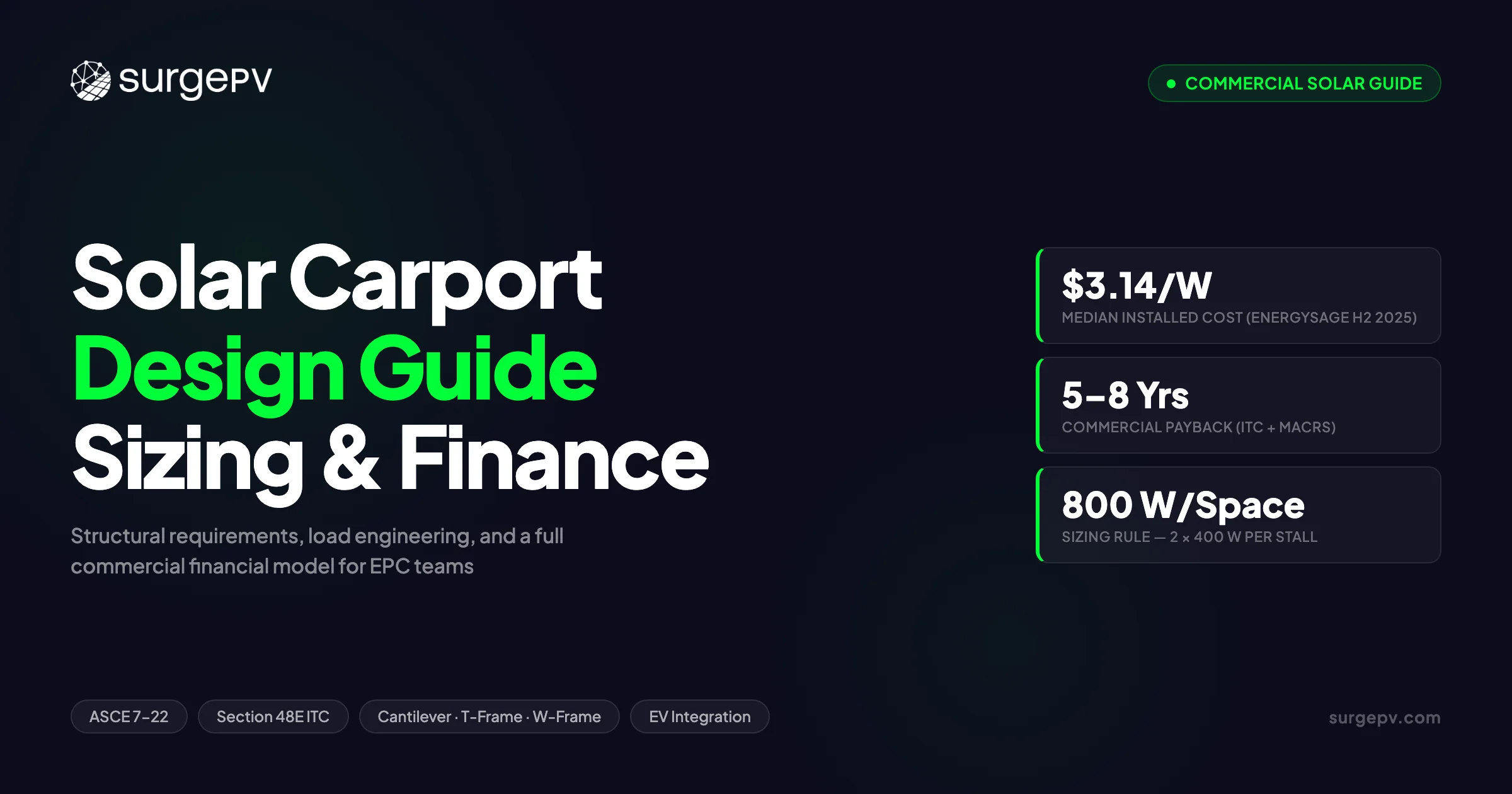
1 parking space ≈ 800 W DC (2 × 400 W panels) · $3.14/W median installed cost, ~22% above rooftop · Commercial payback: 5–8 years with 30% ITC + MACRS · ITC deadline: construction START before July 4, 2026 · Governing standard: ASCE 7-22 (open building classification — not ground-mount tables) · Min clear height: 3.0 m standard; 4.2–4.8 m fire lanes
Why Solar Carports Occupy Their Own Engineering Category
A solar carport is a freestanding open canopy. It has no building envelope. Wind strikes all four sides — and the underside. That is what separates it structurally from every other solar mounting category, and it is where scoping errors originate.
Ground-mount racking sits 0.5–2 m above grade. The steel members are relatively short, and the wind height factor (Kz) reflects low exposure. A carport structure sits 3–5 m above grade. At that height, Kz is meaningfully higher, and the open-canopy geometry means the structure simultaneously experiences uplift pressure on the lower panel surface and downward pressure on the upper surface. Ground-mount tables do not model that combined pressure case. When a project team pulls ground-mount wind coefficients and applies them to a carport design, they typically underestimate design wind pressure by 10–15%. That error works its way into undersized purlins, undersized foundation anchors, and ultimately a plan check rejection.
Rooftop solar has a different problem: the host building structure carries the load, and the building permit for the host structure already exists. A carport has no host. The foundation is designed from scratch, the permit is independent of any existing structure, and the column height is set by clearance requirements — not terrain. A 4.5 m column height requires substantially deeper piers under equivalent wind loading than a 3.0 m column, and that relationship is not linear.
Three decisions drive every other design choice in a carport project: clear height, structural type, and tilt angle. They interact directly. A taller column raises the centroid of wind load, increasing the foundation overturning moment. A steeper tilt increases effective panel plane height and wind uplift. Get these three locked in before any steel sizing begins. Commercial carports commonly require project-specific structural engineering and may require a licensed engineer of record; confirm the applicable requirement with the project AHJ and licensing board.
Scope Note
This guide covers commercial C&I carports of 20 or more parking spaces. Residential carports follow the same engineering logic at reduced scale, but residential load tables, material choices, and financial incentives differ. Residential-specific notes are flagged where relevant.
Structural Types — Cantilever, T-Frame, and W-Frame
Structural type determines column count, foundation strategy, steel quantity, and total cost. There are four practical configurations for solar carports.
Cantilever (single-column) structures use one column per bay, with the panel structure cantilevering outward from that single support point. The appeal is minimal footprint — one column per row, typically in the center of the drive aisle side, leaves the parking stall free of obstructions. The engineering constraint is the moment arm. All wind and gravity loads resolve at a single column base, which requires deep bored piers and heavy-section columns. Foundation cost is disproportionately high relative to panel area covered. Use cantilever only when retrofit conditions prohibit placing columns in normal T-frame positions — for example, when a drive aisle column would block an existing underground utility or storm drain.
T-Frame (two-column) structures carry the canopy on two columns per bay, one on each side of the parking row. This splits the moment and brings foundation costs into normal range. The span sweet spot is 7.5–8 m. Push past 8 m and purlin sections get heavy; drop below 7 m and column frequency increases construction cost per bay. T-frame is the most common structure in US commercial carport projects.
W-Frame (multi-bay) joins two T-frames with a shared drive-aisle column between rows. The result is a continuous double-row canopy. W-frame is the most cost-effective option per watt installed at large lot scale because it eliminates half the columns along the drive aisle and shares foundation work between rows. Coordination with parking geometry is critical — the shared column must land in the drive aisle, not in a stall.
Material choice is straightforward at commercial scale: hot-dip galvanized steel for everything above a residential carport. Aluminum is appropriate for residential carports of 1–3 cars, but it lacks the load capacity needed for large spans or high snow loads. Do not spec aluminum for any project that will carry more than 40 kg/m² snow load or span beyond 6 m.
| Structure Type | Best For | Foundation | Optimal Span | Material | Typical Use Case |
|---|---|---|---|---|---|
| Cantilever | Tight/retrofit lots | Deep bored piers | 4–6 m | Galvanized steel | Narrow rows, restricted column zones |
| T-Frame | Standard commercial lots | Spread footing or piers | 7.5–8 m | Galvanized steel | Most C&I carport projects |
| W-Frame | Large multi-row lots | Shared piers between rows | 15–16 m (double-row) | Galvanized steel | High-volume parking, economy of scale |
| Residential | 1–3 car residential | Concrete pad or piers | 3–5 m | Aluminum | Home carports, light loads |
Pro Tip
Choose cantilever when site conditions require it — not as a default. The foundation premium runs 20–35% above T-frame per bay. If underground utilities or ADA path-of-travel requirements force single-column placement, price both options with a structural engineer before committing. On retrofit projects with complex underground infrastructure, cantilever sometimes pencils out because it eliminates the excavation risk of hitting buried lines.
Load Engineering — Wind, Snow, and ASCE 7-22 Requirements
ASCE 7-22 is the governing standard. Solar carports fall under the open building classification — ASCE 7-22 Chapter 27 for main wind force resisting systems. This is where the most consequential engineering errors occur.
Wind Loading
An open canopy generates pressure on both the top and bottom panel surfaces simultaneously. In rooftop or ground-mount scenarios, the panel is attached to or near a structure that creates aerodynamic shelter. In an open carport canopy, no such shelter exists. ASCE 7-22 defines Net Pressure Coefficients (CN) specifically for open buildings. These coefficients account for simultaneous uplift and downward loading. When a project applies standard ground-mount Cf coefficients instead, the uplift case is typically underestimated by 10–15% — sometimes more at corner bays, where edge effects amplify pressure.
The velocity pressure exposure coefficient (Kz) increases with height. A ground-mount panel at 1 m height in Exposure Category C carries a Kz of approximately 0.85. A carport canopy at 4.5 m carries Kz ≈ 0.98. That 15% increase in velocity pressure translates directly into member sizing. Calculate Kz for the actual mean roof height of the carport — not ground-mount tables.
Snow Loading
Snow is often the governing load in northern climates and is the most undermodeled case in carport submittals. Ground snow loads in northern US jurisdictions reach 180 kg/m² in some zones. On a mono-slope canopy — the most common tilt configuration — unbalanced snow loading creates torsional stress in the primary framing. Half the canopy may be partially loaded while the upslope half carries full drift load. This asymmetric case stresses the connections and secondary members in ways that a symmetric balanced-load analysis misses entirely.
Deflection limits are another common error point. L/120 is appropriate for some secondary framing but not for primary structural members under sustained snow load. Use L/180 for primary rafters and purlins in moderate climates; use L/240 in zones with sustained heavy snow. Specify this explicitly in the structural notes — plan checkers flag deflection limit omissions.
Dead Load Allowance
Design the primary steel for 5–10 kg/m² of miscellaneous dead load above panel weight. This covers future EV charger conduit and junction boxes, general-purpose 120V outlets at columns, LED canopy lighting, and directional signage. Adding this load after steel is fabricated is expensive. Add it in the original design.
Foundation Sizing
Foundation design requires two independent load combinations: uplift (wind pulling the structure vertically upward, which governs anchor bolt design and pier embedment depth) and overturning (wind pushing laterally, which governs pier diameter and concrete strength). Uplift typically governs for carport foundations — the opposite of rooftop solar, where gravity usually controls. Size foundations for both cases and call both out explicitly in the structural calculations submitted for permit.
Three Most Common Structural Errors in Carport Plan Check Submittals
1. Using ground-mount wind pressure tables instead of ASCE 7-22 open building provisions — underestimates design pressure by 10–15%.
2. Applying L/120 deflection limits to primary members in snow zones — correct limit is L/180 or L/240.
3. Ignoring unbalanced snow load on mono-slope frames — this is the torsional case that governs connection sizing in northern climates.
Clear Height Requirements and Column Geometry
Clear height is set by the vehicle mix on the site — and by AHJ fire authority requirements, which can override the vehicle-mix answer entirely. Confirm both before finalizing column heights.
Standard passenger vehicles require 3.0 m (9.8 ft) minimum clearance. This covers standard sedans, SUVs, and light trucks, and satisfies the base requirement at most commercial AHJs. Do not design to this minimum if the site receives any delivery traffic.
Delivery vans and service vehicles — panel vans, ambulances, box trucks — require 3.6–4.2 m. Commercial lots that receive regular deliveries, food service, or maintenance vehicles must design to this range. Underestimating the vehicle mix is one of the more common field problems on completed carports: the structure passes plan check for passenger vehicles and then fails practical use when a delivery van arrives.
Fire lanes are governed by IFC Section 503, which requires a minimum 4.2 m (13.8 ft) clear height for fire apparatus access roads, with some AHJs enforcing 4.8 m. Fire lane designation is determined by the fire authority — it is not the same as the drive aisle designation on the parking plan. Confirm with the AHJ which lanes are designated fire lanes before setting column heights.
ADA van-accessible spaces require 2.49 m (98 inches) under the federal ADA standard. This is a lower bound for those specific stalls, not a design target. The accessible stalls must maintain the full clear height of the carport canopy above them — the 2.49 m figure applies to the van’s structural need, not to a reduced canopy height at ADA spaces.
Column height is a structural input that cascades through the entire design. A 4.5 m clear height column carries a longer moment arm than a 3.0 m column under identical wind loading — and the foundation sizing reflects that difference nonlinearly. Height changes after engineering is complete require full structural recalculation.
| Vehicle Class | Min Clear Height | When Required |
|---|---|---|
| Standard passenger vehicles | 3.0 m (9.8 ft) | All carport projects |
| Delivery vans, service vehicles | 3.6–4.2 m | Commercial lots receiving deliveries |
| Fire lane access (IFC) | 4.2–4.8 m | Any fire lane designation — confirm with AHJ |
| ADA van-accessible parking | 2.49 m (98 in) | Federal ADA requirement — at accessible stalls |
Pro Tip
Get the fire lane designation in writing from the AHJ fire marshal before issuing structural drawings for engineering review. Some municipalities enforce 4.8 m where IFC requires only 4.2 m. A 0.6 m difference in column height changes foundation sizing, steel weight, and project cost — it is not a field adjustment.
Sizing the System — Panels, Rows, and the 800 W Rule
The US standard parking stall is 9 ft wide × 18 ft deep (2.74 m × 5.49 m). That stall width is the base unit for all carport panel layout math.
Two landscape-oriented 400 W panels fit across a standard stall width with adequate framing clearance on each edge. The result is the 800 W DC per space rule of thumb — a reliable first-pass estimating number before actual CAD layout is available. Use it to set project expectations in early client conversations, then replace it with a real count once site plans are in hand.
Row capacity scales predictably:
- Single-car span (12–15 ft wide): accommodates 6–8 panels per row = 2.4–3.2 kW per row
- Double-car span (18–20 ft wide): accommodates 12–16 panels per row = 4.8–6.4 kW per row
A 100-space lot in a double-row W-frame layout typically supports 200–250 kW DC. The reason this exceeds a simple 100 × 800 W = 80 kW calculation is that rows span multiple stalls efficiently. Panels are placed continuously along the carport structure, not one pair per stall — a 50-stall row carries a continuous panel array, not 50 discrete panel pairs. The 800 W figure is a planning estimate; the actual layout is always denser.
From the gross panel count, apply four deductions: drive aisles (no panels span active traffic lanes), column exclusion zones (panels cannot overhang column attachment points beyond structural limits), ADA spaces (maintain clear height — panels present, but verify structural notes), and fire lane setbacks where AHJ requires panel-free zones above designated lanes.
Use solar design software to test row configurations against the actual site CAD. Software tools let you model stall-by-stall layouts, apply real exclusion zones, and output accurate panel counts before a structural engineer is engaged. For remote pre-scope — when site plans are not yet available — see remote solar site assessment for methodology.
| Configuration | Stall Width | Panels per Row | DC Capacity |
|---|---|---|---|
| Single-car span | 12–15 ft (3.6–4.6 m) | 6–8 × 400 W | 2.4–3.2 kW |
| Double-car span | 18–20 ft (5.5–6.1 m) | 12–16 × 400 W | 4.8–6.4 kW |
| 100-space lot (double-row layout) | Full lot | ~500–625 × 400 W | 200–250 kW |
Pro Tip
Use the design software to test multiple row orientations before committing to a layout. East-west configurations can increase panel density by 10–20% on some lots — particularly on lots with north-south drive aisles — because panels can be placed at lower tilt with tighter row spacing without inter-row shading penalties. Run the actual layout, not just the 800 W rule.
Tilt Angle Selection — Energy Yield vs. Structural Load Trade-off
Commercial carports are most commonly installed at 10–15° tilt. That range is not arbitrary. It represents the equilibrium point across four competing factors: annual energy yield, wind uplift load, water runoff and panel self-cleaning, and structural steel cost.
Lower tilts (5–10°) reduce wind uplift meaningfully, which simplifies purlin sizing and often reduces foundation demands. The yield penalty is minor in Sunbelt climates where diffuse irradiance is already high. East-west bifacial configurations at 5–10° tilt can achieve panel density gains that partially offset the yield-per-panel reduction on large flat lots. See the bifacial solar panel design guide for detailed guidance.
Higher tilts (20–25°) improve snow shedding on northern lots where accumulated snow can reach design load within hours of a storm event. They also improve self-cleaning with rainwater runoff and deliver measurably better yield above 40°N latitude. The structural cost of going higher is real: the effective panel plane height increases, wind uplift on the lower panel surface increases, rafter and purlin section weights go up, and the connection detail at the ridge becomes more complex.
The 25° threshold in snow climates is an industry-observed breakpoint, not a code requirement. Above 25°, the additional structural analysis and steel required to carry the increased wind uplift typically exceeds the marginal yield benefit. Projects with steep tilts in high-snow jurisdictions warrant an independent structural review of the wind-snow combined load case before the tilt angle is locked.
East-west bifacial arrays at 5–10° on large commercial lots are worth evaluating separately. They produce a more consistent generation profile across the day, reduce inter-row shading losses, and can achieve panel densities not possible with conventional south-facing layout. Model both orientations with actual irradiance data before deciding.
Shadow analysis software must be part of the tilt selection process — tilt and inter-row spacing interact directly to determine shading losses, and a 3° tilt change can shift annual yield by 1–2% at northern latitudes. Do not finalize tilt angle without running the energy model. When using solar software to model multiple tilt scenarios, export the yield comparison table and include it in the structural engineering brief so the engineer understands the basis for the tilt selection.
| Climate Zone | Latitude | Recommended Tilt | Key Constraint |
|---|---|---|---|
| Sunbelt | Below 35°N | 10° | Wind load dominates |
| Mid-latitudes | 35–45°N | 12–15° | Balance of yield and wind |
| Northern climates | Above 45°N | 15–20° | Snow shedding justifies added structural cost |
| High snow, steep tilt | Any | Above 25° | Requires independent structural review |
Energy Model Required
Tilt must be confirmed in the energy model, not set by rule of thumb. A 3° change can shift annual yield by 1–2% at northern latitudes — on a 220 kW system, that is 5,500–11,000 kWh/year and $770–$1,540 in annual savings. Run the model before the structural engineer starts steel sizing.
Electrical Design Requirements for Carport Systems
Solar carport electrical design follows the same code framework as other PV systems — NEC Article 690 for the PV system itself, NEC Article 706 if battery storage is added — but the physical geometry of a parking structure introduces several carport-specific requirements. Read Adding Battery Storage Services for a complete walkthrough.
String Sizing and Cold-Temperature Voc
String sizing for carports uses the same cold-temperature Voc × 1.25 safety factor as any other PV system. The carport-specific issue is conduit run length. Roof installations typically have short conduit runs from arrays to inverters. Carport conduit runs travel down column bases, under parking lot pavement, and often to an equipment room at the lot perimeter — runs of 50–150 m are common on large lots. String lengths must be calculated using actual conduit routing, not panel count alone. A string that is code-compliant on paper can produce excessive voltage drop in practice if conduit routing is not modeled.
Conduit Protection
Column-base conduit — where conduit transitions from vertical column to below-grade burial — requires bollard protection or steel protective sleeves. Vehicle strikes at column bases are a documented failure mode on unprotected installations. Detail the bollard or sleeve explicitly in the electrical plan set.
Drive-aisle conduit buried under active traffic areas must be Schedule 80 PVC or rigid metal conduit, with burial depths per NEC Table 300.5. Many plan checkers flag carport submittals that use Schedule 40 PVC under drive aisles — the conduit fill table is not the only compliance issue; conduit type and depth are independent requirements.
Grounding
Equipment grounding conductors (EGC) are required per NEC 690.45. The structural steel of a carport may qualify as a grounding electrode under NEC 250.52 — but this requires confirmation with the AHJ and explicit documentation of all bond connections in the electrical plan. Do not assume structural steel serves as grounding electrode without AHJ acceptance; some jurisdictions require a separate driven ground rod or concrete-encased electrode.
Inverter Placement
Inverters must be accessible for maintenance without requiring personnel to enter active traffic lanes. On large lots, this means placing inverters in an equipment enclosure at the lot perimeter, adjacent to a landscape buffer or building wall. Avoid placing inverters in the interior of the parking lot where maintenance access requires parking lot entry during business hours.
Multi-Tenant Metering
Commercial carports serving multi-tenant facilities, or carports where solar output is apportioned to multiple building meters, require revenue-grade metering at each metering point. Flag this requirement early in the interconnection application — utility interconnection requirements for metered generation can add 4–8 weeks to the interconnection timeline if revenue metering is not anticipated.
Solar design software with string layout tools can flag Voc compliance and voltage drop issues before the electrical plan set is drafted, reducing the chance of first-cycle corrections on the electrical permit.
Five Items the Electrical Plan Set Must Show to Pass First-Cycle Plan Check
1. Cold-temperature Voc calculation showing 1.25× safety factor applied.
2. Conduit routing plan with burial depths and conduit type called out for each segment.
3. Column base protection detail — bollard or protective sleeve for below-grade conduit transitions.
4. Inverter location dimensioned relative to active traffic lanes with maintenance access path shown.
5. Grounding electrode and bond documentation — including AHJ basis for structural steel electrode if applicable.
EV Charging Integration — Design Considerations and Load Impact
A solar carport is the natural host for EV charging infrastructure. The canopy structure, the electrical service connection, and the shading benefit are already present. Co-locating EV charging should be part of the original design brief on any commercial lot built after 2024.
Structural Accommodation
EV charger pedestals mount at column bases, which is the correct location to avoid parking-lane obstructions. The 5–10 kg/m² miscellaneous dead load allowance in the structural design covers the conduit, junction boxes, and cable management hardware that route from panels through columns to pedestals. Pedestal bases need bollard protection identical to column-base conduit — vehicle strikes are the most common EV charger damage mechanism on commercial lots.
Electrical Sizing
Level 2 charging (J1772) draws 7.2 kW per port at 240V/30A. A 10-stall EV section adds approximately 72 kW of connected load. A 220 kW carport system can theoretically supply this directly during peak solar hours — but the load and solar output curves will not align perfectly. Grid interconnection must be sized to handle the full EV load plus building load during low-solar periods. Battery storage sized to bridge the midday-to-evening gap is worth modeling; it substantially improves EV self-consumption metrics.
DC fast charging (50–150 kW per port) is a different service category. It requires a dedicated service entry, separate utility interconnection analysis, and potentially a distribution transformer upgrade. Do not integrate DCFC into a carport electrical design without a separate load study.
The financial model should include EV charging as a separate revenue or savings line. Per-port fuel savings for employees using Level 2 charging run approximately $500–$1,200/year depending on local electricity rates and charger utilization. Include this in the client proposal, clearly labeled as a separate benefit from the solar generation savings.
Incentive Stacking
The federal NEVI program and state EV infrastructure incentive programs can stack with the solar Section 48E ITC. Stacking eligibility is site-specific and incentive-specific — flag it for the owner to investigate with a tax advisor, but do not include unverified incentive values in the financial model.
Pro Tip
Rough-in EV conduit during carport construction even if chargers are deferred by 2–3 years. Retrofit conduit through an existing parking lot — cutting pavement, boring under drive aisles, patching asphalt — costs 3–5× what the same conduit costs during new construction. The marginal conduit cost during construction is under $15/linear foot. Retrofit runs $45–$75/linear foot or more.
Financial Modeling — Worked Example for a 100-Space Commercial Lot
This model uses a 100-space commercial parking lot in New Jersey: high commercial electricity rates (~$0.14/kWh commercial average), a snow climate that warrants 15° tilt, and a strong ITC jurisdiction. The numbers represent a realistic mid-market C&I carport project, not a best-case scenario.
Step 1: System Size
Starting from the 800 W rule: 100 spaces × 800 W = 80 kW base estimate. With a full W-frame double-row layout applied to the actual lot geometry — where rows span multiple stalls continuously — the real panel count supports a 220 kW DC system. This is the number carried through the rest of the model.
Step 2: Gross Installed Cost
220 kW × $3.14/W (EnergySage H2 2025 median for commercial carports) = $690,800 gross.
Step 3: Section 48E ITC (30%)
$690,800 × 30% = $207,240 federal tax credit. Construction must START before July 4, 2026, per the current ITC deadline under Section 48E. Net after ITC: $483,560. Note that “construction start” means either physical work of a significant nature on the project or the 5% safe harbor (5% of total project cost incurred before the deadline) — confirm which applies with a tax advisor.
Step 4: Domestic Content Bonus (+10%)
An additional 10% ITC bonus is available if qualifying US-manufactured steel, iron, and manufactured products are used per IRA domestic content requirements. That adds $69,080. Net after both incentives: $414,480.
Step 5: MACRS 5-Year Depreciation
The depreciable basis is the gross installed cost minus 50% of the ITC claimed: $690,800 − (50% × $207,240) = $690,800 − $103,620 = $587,180. With the domestic content bonus applied separately, the adjusted depreciable basis is $690,800 − 50% × ($207,240 + $69,080) = $690,800 − $138,160 = $552,640. At a 25% effective corporate tax rate on the full MACRS deduction over 5 years, the tax benefit is approximately $138,160.
Combining ITC + domestic content + MACRS: net project cost after all incentives is approximately $276,320. Exact figures depend on the owner’s tax position, placed-in-service year, and bonus depreciation elections — use a tax advisor for project-specific modeling.
Step 6: Annual Energy Production
220 kW × 1,250 kWh/kW (New Jersey-specific yield estimate for south-facing 15° tilt, based on NREL PVWatts data for the Newark area) = 275,000 kWh/year.
Step 7: Annual Savings
275,000 kWh × $0.14/kWh commercial electricity rate = $38,500/year.
Step 8: Simple Payback
$276,320 ÷ $38,500 = 7.2 years — within the 5–8 year commercial target range. Projects with higher local electricity rates or domestic content bonus confirmed will land in the lower half of that range.
Step 9: Property Value Addition
Carport solar installations are increasingly captured in commercial property appraisals as income-producing assets. An appraised value addition of approximately $3.50/W installed (based on income approach appraisal methodology) yields approximately $770,000 for this 220 kW project. This is an appraisal-based estimate, not a guaranteed market outcome.
Step 10: 25-Year Outlook
At standard commercial discount rates (7–10%) and factoring a 0.5%/year panel degradation curve, this project generates a positive NPV over its 25-year design life at current electricity rates. Rate escalation — which has run 2–4% annually in commercial markets over the past decade — improves the NPV case.
For residential context: a 5 kW residential carport costs $15,750–$22,500 before incentives (at $3.15–$4.50/W). No federal residential ITC applies — the Section 25D residential credit expired December 31, 2025. Residential payback runs 9–13 years, driven by lower electricity rates and the absence of MACRS depreciation.
| Line Item | Value |
|---|---|
| System size | 220 kW DC |
| Gross installed cost | $690,800 ($3.14/W) |
| Section 48E ITC (30%) | −$207,240 |
| Domestic Content Bonus (10%) | −$69,080 |
| MACRS benefit (est. 25% rate) | −$138,160 |
| Net project cost | ~$276,320 |
| Annual energy production | 275,000 kWh |
| Annual electricity savings | $38,500 |
| Simple payback | 7.2 years |
| Property value addition | ~$770,000 |
Run site-specific yield estimates with the generation and financial tool before presenting numbers to a client. The NJ yield figure used here changes substantially for projects in lower-irradiance or higher-irradiance markets.
Model Your Carport Project in SurgePV
Run site-specific yield estimates, financial models, and proposal outputs — built for commercial EPC teams.
Book a DemoNo commitment required · 20 minutes · Live project walkthrough
For a direct comparison, see Arka 360 vs SurgePV.
Permitting and Plan Check — What Gets Projects Rejected
Most commercial solar carport projects require two simultaneous permit tracks: a building permit (covering structural design per IBC and ASCE 7-22) and an electrical permit (covering PV system per NEC 690 and, if applicable, NEC 706 for storage). Some AHJs add a third permit track for foundation work, particularly in seismic zones or where bored piers exceed a threshold depth. Confirm the permit structure with the AHJ before submitting — a missing permit track discovered after initial submittal costs weeks.
Five Most Common First-Cycle Correction Items
Five Common Plan Check Corrections for Solar Carports
1. Wind calculation not using ASCE 7-22 open building provisions — ground-mount or enclosed building coefficients are flagged immediately by experienced plan checkers.
2. Structural drawings missing column base detail — the column base must show the anchor bolt pattern, bolt diameter, embedment depth, and calculated uplift capacity with the design load that it resists.
3. Electrical single-line missing cold-temperature Voc calculation — the 1.25× safety factor must be shown with the temperature source (ASHRAE 99% design temperature for the project location).
4. Clear height not called out explicitly on the architectural site plan — “see structural” is not accepted by most AHJs; clear height must appear on the architectural sheet with vehicle class basis noted.
5. Grounding electrode and bond documentation missing or incomplete — specify the electrode type, the conductor size, and the bond connection points for all structural steel and equipment enclosures.
Fire Authority Review
Fire authority review is separate from the building permit plan check at most jurisdictions. The fire marshal reviews clear height on designated fire lanes, fire lane access continuity (carport columns cannot reduce fire lane width below IFC minimums), Knox box or equivalent emergency access requirements for electrical equipment, and sprinkler head clearances where the carport is attached to or within a specified distance of a sprinklered building. Submit to the fire authority in parallel with the building department — sequential review adds 4–8 weeks.
ADA Documentation
The site plan must show that ADA accessible parking stalls maintain their required clear height under the carport canopy, that the accessible path of travel from accessible stalls to building entries is not interrupted by new column placements, and that accessible stalls are not relocated or removed to accommodate carport foundations.
Special Inspection
High-wind zones (ASCE 7 ultimate design wind speed above 115 mph) and high-seismic zones (SDC D and above) typically require special inspection of foundation concrete placement and anchor bolt installation. Specify the special inspection program in the structural drawings. Projects that proceed without a required special inspection program cannot obtain a certificate of occupancy.
Timeline
Expect 6–12 weeks for commercial plan check at most US AHJs. Submit complete packages — an incomplete submittal that triggers a completeness rejection restarts the queue clock. For a detailed walkthrough of commercial solar permitting scope, see commercial solar system design.
How to Buy Solar Carport Design Services
Supply a current survey, parking and accessible-route requirements, vehicle and fire access, geotechnical data, drainage, utilities, lighting and EV-charging loads, service and interconnection data, equipment, architectural constraints, and governing approvals. Require coordinated layouts, column and foundation design, structural calculations, drainage, electrical diagrams and routing, lighting and charging interfaces, protection, quantities, permit drawings, native files, and revision records.
QA should test parking circulation and clearances, impact protection, column conflicts, load paths, foundations, water management, underground utilities, cable routing, lighting, EV demand, accessibility, and consistency between structural and electrical packages. Remote design does not verify underground services, soil conditions, property boundaries, traffic operation, or installed work without specific field investigations.
Heaven Designs does not publish a dedicated carport service page in its current catalogue. Its civil, structural and detailed-engineering scopes may be relevant, but buyers should confirm carport experience and request a matched sample before assuming coverage.
Disclosure: SurgePV is promoting Heaven Designs through a commercial relationship. Apply the same sample, specialist, interface, field-data, and qualified QA checks to every provider.
Review the Heaven Designs civil and structural scope, visit the Heaven Designs website, and request a carport-specific sample before seeking a quote.
Conclusion
Three actions determine whether a solar carport project reaches construction on time and on budget:
-
Lock in clear height before structural design begins. Height changes after engineering is complete mean a full structural recalculation — new member sizing, new foundation calcs, revised drawings. Confirm the AHJ fire lane designation and the site’s actual vehicle mix before issuing the structural brief. One meeting with the fire marshal at project initiation saves three weeks of redesign.
-
Use ASCE 7-22 open building provisions throughout. Run the full wind pressure calculation using open-canopy Net Pressure Coefficients. Apply L/180 or L/240 deflection limits to primary members in snow climates. Model the unbalanced mono-slope snow load explicitly. These are the three items that most commonly cause plan check corrections and — if missed — structural underperformance in service.
-
Start the ITC clock now. Construction must start before July 4, 2026. Engage a tax advisor immediately on whether the physical work test or the 5% safe harbor applies to your project. The ITC cliff is real, and commercial tax credit positions require planning lead time.
Once the project is scoped, use solar proposal software to package the system design, financial model, and permit-ready documentation into a client-facing proposal that moves deals forward.
Frequently Asked Questions
How many solar panels fit on a carport per parking space?
A standard 9 ft × 18 ft US parking stall (2.74 m × 5.49 m) accommodates two landscape-oriented 400 W panels across its width, with adequate framing clearance on each edge. That gives approximately 800 W DC per space as a planning estimate. A 100-space lot in a W-frame double-row layout typically supports 200–250 kW DC — meaningfully above the simple 100 × 800 W = 80 kW calculation — because rows span multiple stalls continuously rather than placing two discrete panels per individual stall. The 800 W figure is a pre-design estimating tool. Replace it with a real panel count from the actual site CAD as soon as drawings are available.
What is the minimum clear height for a solar carport?
Standard passenger vehicles require 3.0 m (9.8 ft) minimum clearance, which satisfies the base AHJ requirement at most jurisdictions. Delivery vans and service vehicles require 3.6–4.2 m. Fire lanes designated by the local fire authority must meet IFC Section 503 requirements of 4.2–4.8 m — some AHJs enforce the upper end of that range. ADA van-accessible parking spaces are subject to the federal 2.49 m (98 inch) minimum under ADA Standards for Accessible Design. Design for the most demanding vehicle class present on the site, and confirm the fire lane height requirement directly with the AHJ fire marshal before finalizing column heights.
How much does a commercial solar carport cost per watt?
The EnergySage marketplace median installed cost for commercial solar carports in H2 2025 is $3.14/W, with a range of approximately $3.15–$4.50/W depending on structural type, site complexity, and regional labor costs. That is roughly 22% above commercial rooftop solar ($2.58/W) and slightly below commercial ground-mount ($3.26/W) once avoided paving costs are factored into the comparison. Cantilever structures carry a 20–35% foundation cost premium over T-frame. Projects in high-seismic or high-wind zones trend toward the upper end of the cost range. For the latest details on France, see Agricultural Solar Case Study. Read more about Floating Solar Farms France.
What is the commercial payback period for a solar carport?
With the 30% Section 48E ITC and MACRS 5-year depreciation, commercial carport payback typically runs 5–8 years at average US commercial electricity rates. The worked example in this guide — a 220 kW system in New Jersey at $3.14/W and $0.14/kWh — produces a 7.2-year simple payback after all incentives. Projects in markets with higher electricity rates (California, Hawaii, northeastern states) land in the 5–6 year range. Residential carport payback is substantially longer at 9–13 years, because residential electricity rates are lower, MACRS does not apply to residential systems, and the residential Section 25D tax credit expired December 31, 2025.
What structural standard governs solar carport design?
For US projects, confirm the locally adopted structural standard and amendments rather than assuming one edition applies nationally. Open-canopy wind behavior can differ from ordinary ground mounts, including uplift, downward pressure, and edge effects. The responsible structural professional should select and document the applicable classification, method, loads, and combinations. Confirm engineer-of-record and sealing requirements with the project AHJ and licensing board.
What tilt angle should a commercial solar carport use?
10–15° is the most common commercial carport tilt range. It balances annual energy yield, wind uplift loads, panel self-cleaning with rainwater runoff, and structural steel cost. Higher tilts (15–20°) are appropriate for sites above 45°N latitude where snow shedding is a priority and the yield improvement at steeper angles exceeds the structural cost premium. Tilts above 25° in snow climates warrant an independent structural review of the combined wind-snow load case. East-west bifacial configurations at 5–10° are worth evaluating on large flat commercial lots for density improvements. Always confirm tilt selection in the energy model; a 3° change can shift annual yield by 1–2% at northern latitudes.
Is a solar carport eligible for the federal Investment Tax Credit?
Yes. Commercial solar carports qualify for the 30% ITC under Section 48E of the Internal Revenue Code, provided construction starts before July 4, 2026, and the system is placed in service by December 31, 2027. “Construction start” means either physical work of a significant nature has commenced on the project site, or the 5% safe harbor has been satisfied — 5% or more of the total project cost is incurred by the deadline. An additional 10% Domestic Content Bonus is available if qualifying US-manufactured steel, iron, and manufactured products are incorporated per IRA domestic content requirements. Stacking ITC + domestic content + MACRS 5-year depreciation typically reduces net project cost by 55–65% of gross installed cost. Engage a tax advisor before project commitment.
What electrical code applies to solar carport wiring?
NEC Article 690 governs PV systems, including all solar carport installations. NEC Article 706 applies to battery energy storage systems if storage is added. The carport-specific electrical issues are: cold-temperature Voc sizing using the 1.25× safety factor applied to the ASHRAE 99% design temperature for the project location; conduit run length (carport runs of 50–150 m are common, requiring actual routing analysis rather than panel-count-based string sizing); column-base conduit protection via bollards or steel sleeves; burial depth and conduit type compliance per NEC Table 300.5 for drive-aisle crossings; and inverter placement accessible without entry into active traffic lanes. Grounding electrode documentation — including AHJ confirmation if structural steel is used as the grounding electrode — must appear explicitly in the electrical plan set.