
Quick Answer
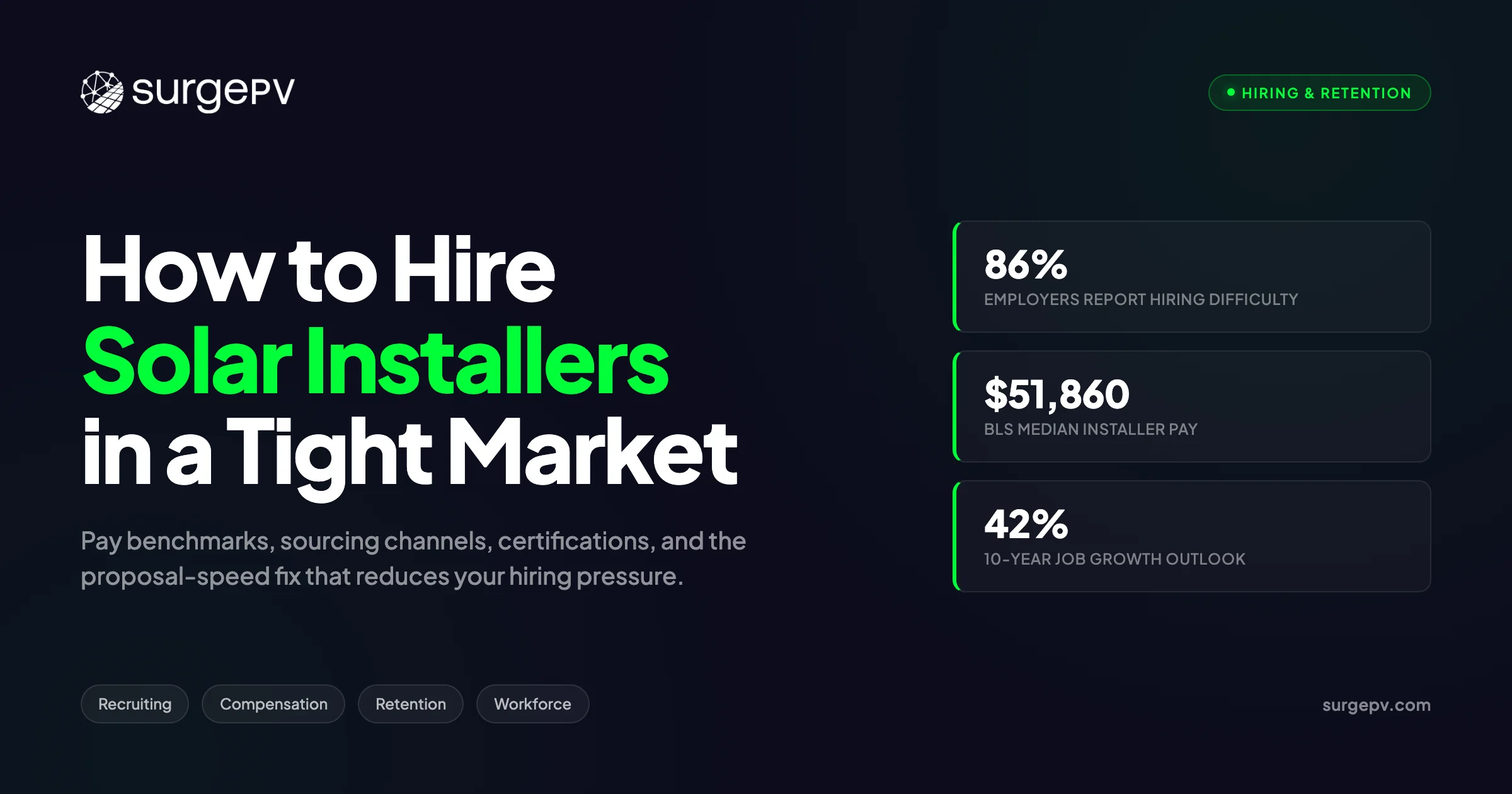
Yet 86% of solar employers report difficulty filling open positions. The share of employers calling hiring 'very difficult' dropped from 44% in 2022 to 26% in 2024. The BLS projects 42% job growth for solar PV installers from 2024 to 2034, generating roughly 4,100 annual openings.
The US solar industry employs 280,119 workers as of the 2024 IREC Solar Energy Workforce Census — 464,053 when you include battery storage. Yet 86% of solar employers report difficulty filling open positions. The contradiction runs deeper than a supply-demand mismatch. The pool of qualified candidates is genuinely thin. The roles that feed installation pipelines — solar designers, project coordinators, lead technicians — sit at the intersection of electrical, structural, and rooftop safety knowledge that no single trade credential covers. And adjacent trades, particularly EV charging and heat-pump installation, are competing for the same candidates. Also see: Us Residential Solar Market Trends 2026.
Yet 86% of solar employers report difficulty filling open positions. The share of employers calling hiring “very difficult” dropped from 44% in 2022 to 26% in 2024. The BLS projects 42% job growth for solar PV installers from 2024 to 2034, generating roughly 4,100 annual openings.
What most hiring guides miss is that the labor bottleneck isn’t always in the field. Many shops with 6 or 8 crews are constrained not by rooftop capacity but by how fast plansets and proposals reach customers. Slow design output means crews wait, deals stall, and close rates drop — creating the illusion of a field labor shortage when the real gap is one designer position (or one workflow tool).
This guide covers the full hiring picture: what the market looks like in 2026, where to source candidates who actually show up, what to pay and require, how to retain the people you bring on, and how to diagnose whether your first fix should be a new hire or a faster proposal system.
TL;DR — Hiring Solar Installers
86% of solar employers report hiring difficulty (IREC, 2024 Census), yet the most overlooked bottleneck isn’t field labor — it’s the designer who keeps crews fed with accurate plansets. This guide covers what to pay, where to recruit, what to require, and how faster proposal software cuts your effective headcount need.
For United States-specific compliance details, see United States arizona/phoenix. For United States-specific compliance details, see United States california/los-angeles.
In this guide:
- Where the US solar labor market stands in 2026 and which roles are hardest to fill
- Exactly what to pay installers, designers, and project managers (BLS benchmarks)
- Which certifications to require on day one versus sponsor over 6–12 months
- Proven sourcing channels that produce candidates who actually show up
- The 10-point retention checklist that small shops skip most often
- Why a designer-to-crew ratio below 1:3 is silently killing your close rate
- How compressing design-to-proposal time reduces your immediate hiring pressure
The State of Solar Hiring in 2026
The headline numbers from the IREC 2024 Solar Energy Workforce Census tell two different stories depending on how you read them. The share of employers calling hiring “very difficult” dropped from 44% in 2022 to 26% in 2024. That sounds like progress. But 86% still report some difficulty — and the character of the problem has shifted in ways that matter for small and mid-size installers.
The hardest positions to fill are no longer entry-level field roles. 47% of solar employers now report difficulty hiring management-level positions, up 17 percentage points from 2023. Experienced lead technicians, solar designers, and operations managers are scarcer than ever because companies that promoted them internally have been growing too fast to backfill. The pipeline problem is moving up the org chart.
53% of employers cite lack of experience and training as the primary obstacle to filling open roles — not compensation, not geography. The BLS projects 42% job growth for solar PV installers from 2024 to 2034, generating roughly 4,100 annual openings. NREL projections for total solar employment reach 500,000–1.5 million by 2035 depending on policy trajectory. The gap between projected demand and available trained workers is not closing fast enough.
The workforce itself is more diverse than the broader construction trades. The IREC census reports:
| Demographic | Share of Solar Workforce | Change Since 2019 |
|---|---|---|
| Hispanic/Latino | 24% | +7 pp |
| Women | 29% | +3 pp |
| Veterans | 8% | vs. 5% national avg |
| Union members | 12% | — |
Source: IREC 2024 Solar Energy Workforce Census
The veteran share stands out. Solar companies that actively recruit from military transition programs consistently report lower turnover and stronger safety records — two problems that cost small shops disproportionately.
The competitive pressure from adjacent trades is real and accelerating. Heat-pump contractors and EV charging installers draw from the same electrician-adjacent labor pool. Both are growing fast under IRA incentives, and both offer year-round work without the seasonal dips that still affect residential solar in northern markets. If you’re hiring in a competitive metro and your compensation package isn’t benchmarked against HVAC and EV trades, not just solar peers, you’re losing candidates before they even apply.
For small solar installers, the practical implication is straightforward: stop assuming the labor shortage is temporary. Plan your staffing model around it. That means sourcing earlier, training more aggressively, and auditing whether a workflow constraint is disguising itself as a headcount problem.
Where to Find Solar Installers That Actually Show Up
The installers who answer job board posts and the installers who show up, pass their probationary period, and stay past 12 months are often not the same people. Sourcing channel matters as much as compensation.
Trade Schools and Community College Programs
Community college solar programs produce candidates with real hands-on training — module wiring, conduit runs, fall protection — before they ever step on a client’s roof. Programs at institutions like Merced College (CA), Austin Community College (TX), and Lakeshore Technical College (WI) are actively placing graduates. Building a relationship with program directors before a position opens gives you first-look access to top graduates. Expect candidates with 120–300 hours of lab time but no field hours. Budget 4–6 weeks of supervised jobsite work before independent installs.
NABCEP Job Board and LinkedIn Skilled Trades Groups
The NABCEP job board reaches candidates who have already self-selected into professional credentialing. Posts here are more likely to attract candidates with field hours than generic job board listings. LinkedIn’s skilled trades groups — particularly regional solar contractor groups — surface passive candidates who aren’t actively searching but will respond to a direct, specific message. Generic “we’re hiring” posts perform poorly. Direct outreach describing the project type, the crew structure, and the advancement path performs better.
Union Halls (IBEW, NECA)
The IBEW (International Brotherhood of Electrical Workers) and NECA (National Electrical Contractors Association) run apprenticeship programs that produce disciplined, safety-trained candidates with electrical fundamentals. Union installers typically command journeyman wages ($28–$35/hr in most markets), but they come with structured training records, established safety habits, and — for projects over 1 MW — satisfy IRA prevailing wage requirements automatically. If your project mix is shifting toward commercial, a union partnership is worth the cost delta. See Design Commercial Solar System 1MW for detailed guidance.
Military Transition Programs
DoD SkillBridge, Helmets to Hardhats, and the DOE’s Solar for All workforce initiatives all create pathways for transitioning service members into solar installation. Veterans bring physical discipline, safety culture, and team communication skills that are hard to train from scratch. Several solar-specific SkillBridge programs exist with major installers — but smaller companies can apply to host their own. The candidate shows up, you pay nothing during the 90–180 day transition, and you get first option to hire.
Internal Referral Programs
Current crew members know who is good, who will show up, and who will fit the team. A $500–$1,000 referral bonus (paid in two tranches: $250 at hire, $750 at 6 months) costs a fraction of a bad hire’s replacement cost and produces candidates who already understand what the job actually looks like. Most small shops either have no referral program or pay out in one lump sum that doesn’t incentivize the referrer to help the new hire succeed.
Three sourcing mistakes to stop making:
- Posting job listings without a pay range. In most markets, listings without salary transparency get fewer applications from experienced candidates — who have options — and more from inexperienced candidates who don’t know what to benchmark against.
- Requiring NABCEP PV Installation Professional as a prerequisite. This credential requires 1,000–3,000 field hours depending on education level. Listing it as a requirement eliminates nearly your entire candidate pool. List it as a target, not a gate.
- Treating sourcing as reactive. If you only recruit when a position opens, you’ll always be starting from zero. Keep a short list of warm candidates — people who inquired in the past, recent program graduates, referrals who aren’t ready yet — and touch base quarterly.
What to Pay: Compensation Benchmarks by Role and Market
The BLS 2024 Occupational Employment Statistics put the US median for solar PV installers at $51,860/year — $24.93/hour. That figure sits below the journeyman electrician median and nearly even with roofers. That compression is the core of the compensation problem.
| Role | US Median Annual | Hourly Equivalent | Source |
|---|---|---|---|
| Solar PV Installer | $51,860 | $24.93 | BLS 2024 |
| Electrician (Journeyman) | $62,350 | $30.00 | BLS 2024 |
| Roofer | $50,970 | $24.50 | BLS 2024 |
| Solar Designer / Proposal Engineer | $58,000–$72,000 | $27.88–$34.62 | Industry estimates |
| Solar Project Manager | $70,000–$95,000 | $33.65–$45.67 | Industry estimates |
Sources: BLS Occupational Outlook Handbook; Solar designer and PM ranges based on industry-observed compensation data from solar-specific job boards, 2024–2025.
Regional variation is significant. California, New York, Massachusetts, and the Pacific Northwest run 20–30% above the national median. Texas, Florida, and Arizona — the three largest solar markets by volume — run 10–20% above. Rural markets in the Midwest can sit at or below the BLS median, which makes recruiting harder when experienced candidates can relocate to higher-paying metros.
Total compensation matters more than base rate. A candidate evaluating two offers at $25/hr will weigh whether one comes with a company truck, fuel card, and tool allowance while the other requires a personal vehicle and $200/month in fuel costs. In competitive markets, the effective hourly rate difference can be $3–$5/hr once you factor in these items.
IRA prevailing wage rules apply to solar projects over 1 MW seeking the enhanced 30% commercial ITC. Prevailing wages are set by the Department of Labor by locality and occupation. In most markets, prevailing wage for solar installation runs $28–$45/hr depending on classification. If your project mix includes commercial or utility-scale work, benchmark your pay structure against prevailing wage requirements, not just residential market rates.
A practical example: a Texas shop offering $22/hr base with no vehicle allowance was losing candidates to a regional EPC at $26/hr plus a company truck. The EPC’s all-in cost per installer was roughly $38/hr loaded. The small shop’s all-in cost was $31/hr. The difference was visible in the headline number, not the actual cost — a presentation problem that a restructured comp package could have fixed without changing total spend.
Certifications and Training: What to Require vs. What to Sponsor
Cert requirements have a direct effect on your applicant pool size. Set the bar too high and you eliminate qualified candidates who simply haven’t had access to credentialing. Set it too low and you hire people who aren’t safe on a roof.
The right frame is: require what covers liability on day one, sponsor what builds long-term capability.
| Certification | Require on Hire? | Sponsor Timeline | Cost Range | Who Issues |
|---|---|---|---|---|
| OSHA-10 (construction) | Yes | Pre-employment or week 1 | $30–$80 | OSHA-authorized trainers |
| OSHA-30 | No — sponsor within 6 mo | 6 months | $150–$300 | OSHA-authorized trainers |
| First Aid / CPR | Yes | Week 1 | $30–$60 | Red Cross / local |
| NABCEP PV Associate | No — sponsor within 12 mo | 12 months | $250 + prep | NABCEP |
| NABCEP PV Installation Professional | No — target for lead techs | 24–36 months | $450 + prereqs | NABCEP |
| Manufacturer-specific (Enphase, SolarEdge) | Preferred, not required | 30–90 days | Usually free | Manufacturer portals |
Cost ranges are industry-observed; NABCEP fees as of 2025 published schedule.
Context on NABCEP: approximately 18,000 NABCEP credentials have been issued across all categories, and roughly 30% of surveyed solar firms report having at least one NABCEP-certified staff member. The NABCEP PV Installation Professional credential requires 1,000 field hours (with a 4-year degree) up to 3,000 hours (with no post-secondary education). Requiring it as a hiring prerequisite effectively filters out the majority of available candidates, including many who are capable and motivated.
For projects over 1 MW, the IRA’s prevailing wage and apprenticeship requirements add a structural layer: 15% of total labor hours must be performed by registered apprentices. This isn’t optional for the full ITC bonus. If your business is scaling into commercial, start building an apprenticeship pipeline now — not when the first qualifying project lands.
A realistic training timeline for a new hire with no solar background:
- Weeks 1–2: OSHA-10, First Aid/CPR, fall protection, site orientation, shadow crew on 3–5 installs
- Months 1–3: Supervised installations, module handling, conduit runs, string wiring under lead tech oversight
- Months 3–6: Independent residential installs, begin NABCEP PV Associate prep
- Months 6–12: OSHA-30 completion, NABCEP PV Associate exam, begin manufacturer product certifications
- Months 12–18+: Lead tech responsibilities, C&I exposure, begin accumulating NABCEP PV Installation Professional field hours
The Social Finance/DOL data on registered apprenticeship programs shows a 46.8% national completion rate across all trades. Solar-specific programs with structured mentorship and clear advancement paths outperform this average. The completion rate difference comes almost entirely from two variables: schedule predictability and a visible promotion path.
Retention: Why Installers Leave and How to Keep Them
PV Tech research on the operations and maintenance segment puts annual turnover for solar field technicians at roughly 27%. For residential installers, the number is likely higher. The cost of replacing a trained installer — recruitment, onboarding, lost productivity during ramp — typically runs thousands of dollars per departure in direct and indirect costs.
The six most common reasons installers leave, ranked by frequency in exit interviews:
- Inconsistent job volume — too many slow weeks, too many 60-hour crunch weeks
- Pay below electrician peers for equivalent risk and physical demand
- No visible advancement path — same title, same pay, year after year
- Slow operations — waiting on designs, permits, or materials while the clock runs
- Poor equipment or inadequate safety gear
- No recognition — managers know something is wrong only when someone quits
Items 1 and 4 are the ones most directly within a small shop’s control, and both connect to the design bottleneck covered in the next section.
10-point retention checklist:
| # | Action | Cost | Timeline |
|---|---|---|---|
| 1 | Post full compensation range in every job listing | $0 | Immediate |
| 2 | Structured 30-60-90 onboarding plan — written, not verbal | $0 | Week 1 |
| 3 | Sponsor OSHA-30 within 6 months | $300/person | 6 months |
| 4 | Sponsor NABCEP PV Associate within 12 months | $250/person | 12 months |
| 5 | Define a lead tech promotion path with a salary band | $0 | Month 1 |
| 6 | Vehicle or fuel allowance — align with regional norms | $150–$400/mo | Immediate |
| 7 | Schedule predictability — 2 weeks minimum advance notice | $0 | Immediate |
| 8 | Monthly crew check-in (15 min, 1-on-1) | $0 | Month 1 |
| 9 | Referral bonus program ($500–$1,000, two-tranche payout) | Variable | Month 1 |
| 10 | Reduce design wait time — crews should never be idle waiting on plansets | Workflow/software | Immediate |
Item 10 isn’t soft. Consider a 9-person shop that lost two experienced installers in the same month. Exit interviews surfaced two recurring themes: “too much waiting on designs” and “job-to-job uncertainty.” The crew was averaging 1.5 idle days between project completions because plansets weren’t ready when they were. That’s two installers gone and a cause that had nothing to do with pay. The next section covers what to do about it.
The Hidden Bottleneck: You May Not Need More Installers — You Need Faster Proposals
Before posting another installer job listing, run one diagnostic: how many days does it take from a signed lead to a delivered proposal? If the answer is more than 3, you may have a designer bottleneck disguised as a field capacity problem.
The Designer-to-Crew Ratio Problem
Well-run solar shops maintain a designer-to-crew ratio of 1 designer for every 3–5 active crews. Below 1:3, the queue backs up. Plansets arrive late, crews have gaps between jobs, and the owner often fills the design gap by working nights and weekends. That’s not a staffing model — it’s a survivorship pattern.
Most small installers don’t have a dedicated designer at all. The owner designs, or a senior installer designs between jobs, or proposals go out 7–10 days after the site visit. Every day of delay costs close probability.
What Slow Proposals Cost You in Real Terms
Industry-observed close rate data shows a consistent relationship between proposal speed and deal conversion: faster turnaround correlates with higher close rates. Shops that compress proposal turnaround from roughly 6 days to 2 days after changing their design workflow typically see close rate improvements of several percentage points. Same crew size. Same market. The additional revenue from that close rate improvement can fund new hire packages — without adding a single crew member.
The counterintuitive question to ask before hiring installer #7: are installers #1–6 fully utilized? If they’re averaging 4 productive days out of 5 because of design queue delays, adding a seventh crew doesn’t solve the constraint — it deepens it.
What a Solar Designer Actually Does (and Why It’s Hard to Hire)
The solar designer role sits at the intersection of electrical load calculation, structural roof assessment, interconnection rules, shading analysis, and proposal writing. No single trade credential prepares someone for all of it. A journeyman electrician knows single-line diagrams but may not know module layout or string sizing. A CAD drafter knows layout but may not know NEC Article 690. Read Solar Shading Analysis Guide for a complete walkthrough.
This is why 47% of firms report difficulty hiring at the management level (IREC, 2024, +17 pp from 2023). The designer is a management-adjacent role that requires cross-disciplinary knowledge most trades don’t bundle.
Three options when you can’t hire a dedicated designer:
- Train a sharp installer — 12–18 months to full design capability with structured mentorship; the right long-term play but slow
- Outsource plansets — $50–$200 per design, 24–72 hour turnaround; solves the immediate bottleneck but adds variable cost
- Use solar design software that compresses per-design time — the same designer produces more plansets per day, increasing the designer-to-crew ratio without adding headcount
How SurgePV Compresses the Design-to-Proposal Workflow
Solar software built specifically for the installer workflow can cut design-to-proposal time by 60–70% compared to generic CAD tools or manual processes. Here’s what that looks like in practice:
Solar design software like SurgePV handles 3D rooftop modeling, module layout, string sizing, and bill of materials in a single session — not across three separate tools. Shadow analysis runs physics-based shading calculations in the same workflow, so the designer isn’t toggling between a shading tool and a design platform. The Generation & Financial Tool calculates system yield, payback period, IRR, and NPV from the same dataset — no re-entry, no spreadsheet handoff. Solar proposal software generates a branded, customer-ready PDF from the same project file.
Clara AI assists with proposal narrative, pulling from the project data to draft the customer-facing sections that typically consume 30–45 minutes of a designer’s time.
The net result: one designer using a unified workflow can support 4–5 active crews instead of 2. That’s not a feature claim — it’s a ratio shift that shows up in close rates, crew utilization, and whether your best installers are sitting idle on Tuesday mornings waiting for a planset.
See How Much Time Your Team Loses to Slow Proposals
Book a 20-minute walkthrough and we’ll show you the design-to-proposal workflow live — on a real project like yours.
Book a DemoNo commitment required · 20 minutes · Live project walkthrough
2026 Policy Context: What Just Changed
The residential solar ITC (Section 25D) expired December 31, 2025. Homeowners who did not have their systems placed in service by that date no longer have access to a federal tax credit. This is not a phase-down — it is a full expiration. Do not quote this credit to residential customers.
The commercial ITC (Section 48E) remains active under the Inflation Reduction Act. The base credit rate is 6%, stepping up to 30% with prevailing wage and apprenticeship compliance. For solar projects over 1 MW, that 15% apprenticeship labor hour requirement is not optional if you want the full credit. Installers working on commercial jobs need to understand this requirement exists — and it affects how you staff those projects.
The One Big Beautiful Bill Act was signed into law on July 4, 2025, and introduced modifications to IRA clean energy provisions. The residential credit termination took effect December 31, 2025. Commercial projects must generally begin construction by July 4, 2026, to access the full Section 48E credit with standard continuity safe harbor. Build proposals around current law and flag the legislative environment explicitly.
What the policy shift means for staffing: residential demand may soften in 2026 as homeowners absorb the ITC expiration. Commercial and industrial solar continues scaling, driven by corporate clean energy commitments and Section 48E. If your business is primarily residential, plan for a slower first half. If you’re positioned for C&I growth, staff accordingly — the designer and project manager roles become more important at that scale, and prevailing wage compliance creates new administrative requirements.
Heat-pump and EV charging installation continue expanding under separate IRA provisions. Both trades compete for the same electrician-adjacent labor pool as solar. That competition isn’t going away — plan your compensation structure with these adjacent trades in the benchmark set.
Conclusion
The solar hiring market in 2026 is tight but manageable. The shift from “very difficult” to “difficult” across the IREC surveys reflects real progress — more community college programs, more military pipelines, more structured apprenticeships. But 86% difficulty is still a hard number to staff around.
Three actions worth taking this week:
- Audit your designer-to-crew ratio. If one designer supports fewer than 3 active crews, that’s the first position to fill — or the first workflow to fix. Run the numbers on how many proposals went out last month and how long each took.
- Post your compensation range on every listing. The BLS median is $51,860 — if you’re below that in a competitive market, you’re filtering out your best candidates before they apply. If total comp is competitive but base rate looks low, restructure the package before you post.
- Start a cert sponsorship path, even a basic one. OSHA-30 plus NABCEP PV Associate costs under $600 per employee. That’s the highest-signal retention tool available to small shops — it tells a crew member you see them as a 3-year employee, not a seasonal hire.
Design Faster. Close More. Hire Smarter.
SurgePV compresses the design-to-proposal workflow so one designer supports more crews — reducing your immediate hiring pressure.
Book a Free DemoNo commitment required · 20 minutes · Live project walkthrough
For a direct comparison, see Arka 360 vs SurgePV.
Frequently Asked Questions
How much should I pay a solar installer in 2026?
The BLS 2024 median for solar PV installers is $51,860/year, or $24.93/hour. In top solar markets — California, New York, Massachusetts, Arizona — expect to pay 15–25% above the national median to attract experienced candidates. Total compensation structure matters as much as base rate. A package with vehicle allowance, tool coverage, health benefits, and a clear bonus structure will outperform a bare-base offer at the same headline number, particularly when competing against electrician-adjacent trades where total comp packages are often more developed.
What certifications should I require for a new solar installer hire?
Require OSHA-10 and First Aid/CPR at hire — these cover your liability from day one and are inexpensive enough that candidates who lack them can complete both before their first week ends. Sponsor OSHA-30 within 6 months and NABCEP PV Associate within 12 months as part of a defined development path. Do not require NABCEP PV Installation Professional as a hiring prerequisite. That credential demands 1,000–3,000 field hours depending on education, which eliminates the vast majority of available candidates, including capable people who simply haven’t had access to credentialing programs yet.
How long does it take to train a new solar installer from scratch?
A structured mentorship program can produce a candidate capable of independent residential installs in 3–6 months. Full commercial and industrial capability — including C&I string sizing, roof penetration engineering, and interconnection paperwork — typically takes 12–18 months. NABCEP PV Installation Professional eligibility requires between 1,000 and 3,000 field hours depending on the candidate’s education level: 1,000 hours with a 4-year engineering degree, 1,500 with a 2-year program, 3,000 with a high school diploma. Plan your training timeline against those milestones.
Why is it so hard to find qualified solar installers?
53% of employers cite lack of experience and training as the primary obstacle to filling open positions (IREC, 2024 Census). The role requires electrical fundamentals, rooftop structural assessment, shading analysis, and fall protection competency — knowledge that no single trade credential or vocational program fully covers. Electricians know wiring but not module layout. Roofers know penetrations but not NEC Article 690. Solar-specific training programs are growing but haven’t kept pace with industry demand. Adjacent trades — heat-pump installation, EV charging — compete for the same electrician-adjacent labor pool and are also expanding aggressively under IRA incentives.
Should I hire apprentices or experienced installers?
Both, with intentional roles for each. Experienced installers reduce your onboarding burden and can mentor junior crew members — they pay back faster but cost more. Apprentices build your long-term pipeline, satisfy IRA apprenticeship labor hour requirements on commercial projects over 1 MW, and typically stay longer when they can see a development path. A crew structure with 1 lead tech and 2 apprentice-track installers per team serves both goals. The lead tech gets responsibility and a visible promotion path; the apprentices get structured mentorship and a credential timeline. Most small shops that struggle with retention are running all experienced installers with no upward mobility visible to any of them.
How can I reduce my need to hire more installers without slowing down?
The fastest lever is compressing your design-to-proposal cycle. Industry-observed close rates improve as proposal speed increases. Shops that cut proposal turnaround from roughly 6 days to 2 days using solar design software typically see close rate improvements of several percentage points with the same crew size. Before hiring installer #7, ask whether installers #1–6 are fully utilized or whether they’re sitting idle waiting on plansets. If it’s the latter, fix the design workflow first — not the field headcount.