
Quick Answer
Utility-scale and commercial ground-mount additions in the US exceeded 30 GW in 2024, and the trajectory for 2025 is steeper. GHI below 1,400 kWh/m²/yr in most markets; below 1,600 kWh/m²/yr for projects targeting sub-6-year payback Slope and grading. Slope >10%; multi-directional slope changes that prevent uniform row orientation Soil bearing capacity.
Ground-mount solar is growing faster than any other segment. Utility-scale and commercial ground-mount additions in the US exceeded 30 GW in 2024, and the trajectory for 2025 is steeper. The reason is straightforward: rooftop constraints — structural load limits, unfavorable orientations, shading from mechanical equipment — push a growing share of commercial and utility projects to open land. But a designer who applies rooftop logic to a ground-mount project will get the engineering wrong. The workflows, the load calculations, the string sizing assumptions, and the permitting requirements are fundamentally different.
Utility-scale and commercial ground-mount additions in the US exceeded 30 GW in 2024, and the trajectory for 2025 is steeper. GHI below 1,400 kWh/m²/yr in most markets; below 1,600 kWh/m²/yr for projects targeting sub-6-year payback Slope and grading.
This guide covers the complete ground-mount design process: from the 8 criteria that determine whether a site is viable before you open solar design software, through foundation selection, racking, ground coverage ratio (GCR) calculation, ASCE 7-22 wind loads, string sizing, DC wiring layout, and the permitting checklist. Every section includes worked numbers and actionable rules.
TL;DR — Ground-Mount Solar Design
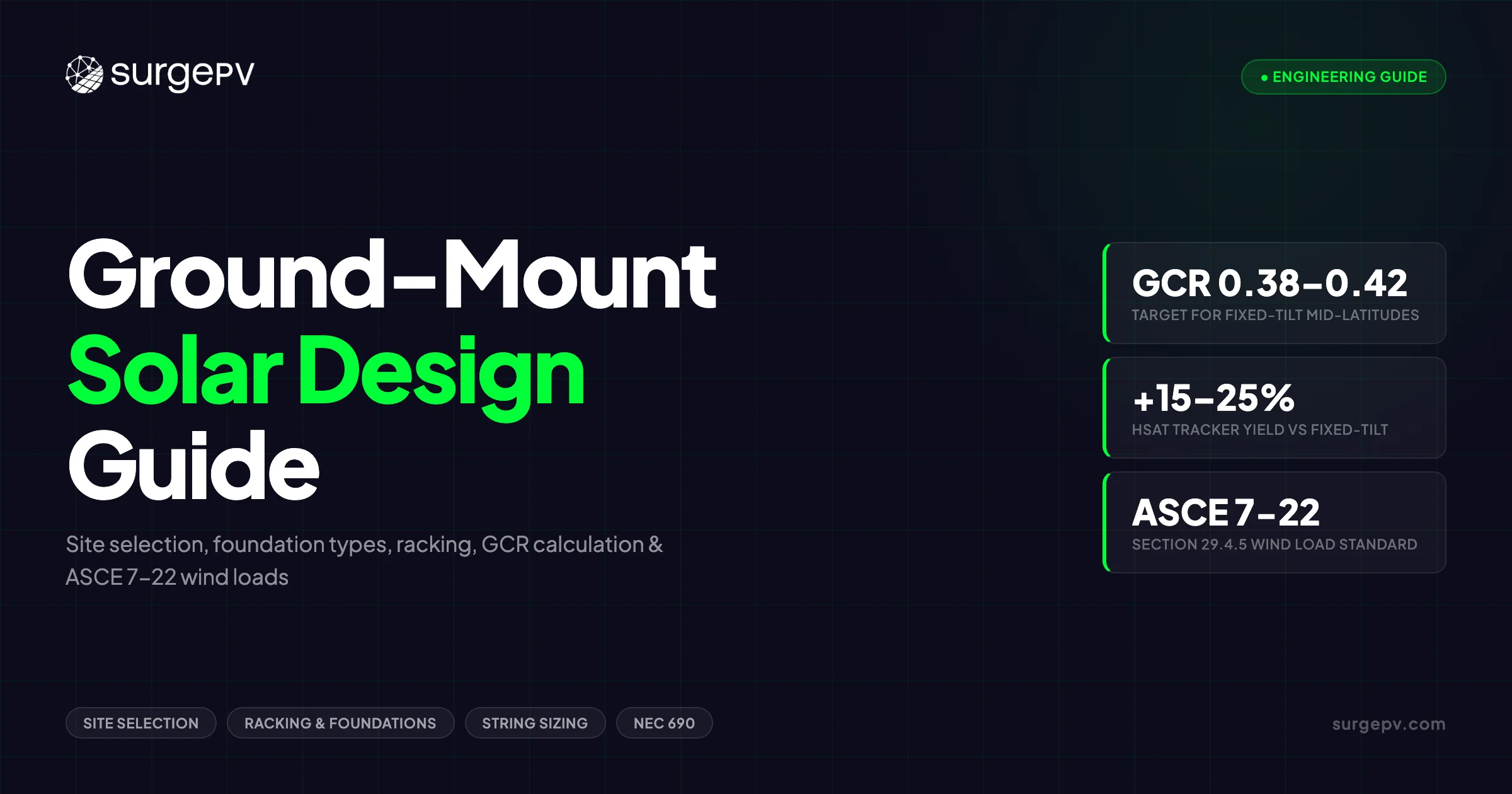
Site viability depends on GHI ≥ 1,400 kWh/m²/yr, slope ≤5%, and SPT N > 20 for driven-pile foundations. Target GCR 0.38–0.42 for fixed-tilt at mid-latitudes. Use ASCE 7-22 Section 29.4.5 for wind loads — ASCE 7-16 tables are no longer acceptable for most AHJs. String Voc calculation must use site-specific ASHRAE 0.4% design temperature, not a default -10°C. Commission a geotechnical investigation before signing the EPC contract.
In this guide:
- 8 site selection criteria with red flags
- Foundation types: driven piles, helical screws, ground screws, ballast, micropiles
- Racking systems: fixed-tilt, single-axis tracker, E-W bifacial — with a decision table
- GCR and row-pitch calculation: worked 500 kWp example at 35° latitude
- Module orientation: portrait vs. landscape for ground mounts
- ASCE 7-22 Section 29.4.5 wind load changes and design example
- String sizing for long DC homerun runs
- DC wiring layout, trenching depth, and combiner box design
- Permitting checklist: 5 permit types with timelines
- 8 common design mistakes and how to avoid them
Site Selection: 8 Criteria Before You Start Designing
A site that fails on one of these criteria can still be built — but at a cost premium that changes the project economics. Evaluate all 8 before committing to layout work.
| Criterion | Why It Matters | Red Flag |
|---|---|---|
| Solar resource (GHI) | Directly drives annual yield and IRR | GHI below 1,400 kWh/m²/yr in most markets; below 1,600 kWh/m²/yr for projects targeting sub-6-year payback |
| Slope and grading | Cut/fill cost increases sharply above 5% grade | Slope >10%; multi-directional slope changes that prevent uniform row orientation |
| Soil bearing capacity | Drives pile type and foundation cost | SPT N-value below 10 throughout the first 3 m — indicates very soft soils requiring driven-pile substitution or micropiles |
| Shading obstructions | Tree lines, structures, and utility poles reduce yield and complicate stringing | Any obstruction within 2× the height-to-distance ratio of the array; deciduous tree line within 20 m of the north edge |
| Grid proximity | Interconnection voltage and cable length affect BOS cost | HV line more than 500 m away without an existing distribution infrastructure; utility upgrade required adds 8–18 months |
| Access and logistics | Crane access for installation; truck access for O&M | No road capable of carrying a 40-ton flatbed within 200 m; no room for a 10 ft access road every 10–15 rows |
| Flood zone | Structural foundation requirements and insurance premiums change significantly | FEMA Zone AE (100-year floodplain) — requires elevated racking structures and significant permitting mitigation; usually a no-go |
| Environmental and permitting | Wetlands buffers and Endangered Species Act species surveys can halt projects mid-design | Any identified wetlands or waterways within 100 ft; known ESA-listed species habitat on-site; high-value farmland in states with active solar overlay restrictions |
Use PVGIS or NASA POWER for GHI data. Both tools provide 10+ year monthly averages that are more reliable than satellite estimates from a single year.
Pro Tip
Run a slope analysis in Google Earth Pro before visiting the site. Set the elevation profile tool along the proposed row direction and across the rows. Sites with a cross-slope (perpendicular to rows) above 3% require pier-height adjustment on every table — that adds cost even when the along-row slope is gentle.
Foundation Types: Choosing the Right System for Your Soil
Foundation type is the largest single variable in ground-mount BOS cost. The right choice depends on soil conditions, installation timeline, whether the site needs to be reversible (agrivoltaic leases, for example), and access for equipment.
| Foundation | Best soil | Install speed | Approximate unit cost | Reversible? |
|---|---|---|---|---|
| Driven steel piles | Firm/cohesive (SPT N > 20) | Fast (hydraulic driver: 150–300 piles/day) | $800–1,500/pile | No |
| Helical screw piles | Soft, loose, or fill soils | Medium (30–80 piles/day) | $2,500–4,000/pier | Yes |
| Ground screws | Rocky or seasonally frozen ground | Fast (purpose-built machine) | $1,500–2,500/screw | Yes |
| Concrete ballast | Any surface-mount application | Slow (cure time) | $200–400/m² | No — easement complications |
| Micropile/grouted | Bedrock or hard rock | Slow (drilling required) | $4,000–8,000/pile | No |
Driven steel piles dominate large-scale projects because the cost per pile and installation speed are unmatched on suitable soils. The critical caveat is soil consistency: if borings reveal fill layers or variable SPT N-values, pile refusal becomes a real risk mid-installation. Also see: Us Residential Solar Market Trends 2026. For United States-specific compliance details, see United States arizona/phoenix.
Pro Tip
For utility-scale sites above 500 kW, commission a geotechnical investigation report before signing the EPC contract. A single soil boring costs approximately $2,000 and takes 1–2 weeks. Foundation redesign after contract execution costs $50,000–$200,000 in schedule delays and re-engineering. The geotech is always worth it.
Helical screw piles are the standard choice for sites with soft soils, high water tables, or lease terms requiring full restoration at end-of-life. They are more expensive per unit but can be unscrewed and removed cleanly — an important consideration for agrivoltaic projects or sites with conditional use permits requiring reversibility.
Ground screws have become common in northern US and Canadian markets where frozen ground makes driven piles impractical for 4–5 months per year and concrete work is impossible in winter. The purpose-built installation machines are increasingly available from rental equipment suppliers. For Canada-specific compliance details, see Canada comparisons/solar-design-software.
Racking Systems: Fixed-Tilt, Single-Axis Tracker, or E-W Bifacial?
The racking decision drives land use, yield, O&M cost, and foundation requirements. Each system type has a distinct economic case.
| System | Best for | GCR range | Yield uplift vs fixed-tilt | Annual O&M cost premium |
|---|---|---|---|---|
| Fixed-tilt | Constrained land, significant shading, systems under 100 kW | 0.35–0.45 | Baseline | $0 |
| Single-axis horizontal tracker (HSAT) | Flat terrain, systems above 200 kW, good direct normal irradiance | 0.28–0.35 | +15–25% | $3–5/MWh |
| East-West bifacial (flat or 5–10° tilt) | Very constrained sites, high land cost, self-consumption optimization | 0.60–0.70 | +8–12% vs conventional fixed | Low |
| Dual-axis tracker | CPV or research applications | 0.10–0.15 | +30–35% | High |
Single-axis horizontal trackers (HSAT) are now the dominant technology for utility-scale ground-mount systems above 500 kW. The three largest tracker providers — NEXTracker NX Horizon, Array Technologies DuraTrack, and GameChange Solar Genius — all offer bifacial-compatible systems with independent-row stow for wind events. The yield uplift of 15–25% relative to fixed-tilt comes primarily from increased morning and afternoon irradiance capture. See Bifacial Solar Panel Design Guide for detailed guidance.
Bifacial modules combined with HSAT is the current utility-scale standard. The tracker’s daily rotation maximizes both front-side irradiance and, at lower GCR, rear-side irradiance from ground albedo. For commercial systems in the 200 kW–2 MW range, HSAT adds $0.04–0.08/Wp in hardware cost but typically recovers the premium within 3–4 years through yield improvement.
East-West bifacial is the right choice when land cost is high or when the system needs to maximize specific yield on a narrow strip. GCR of 0.60–0.70 allows significantly more modules per hectare at the cost of a flatter production curve across the day — which is actually favorable for grid operators seeking midday peak reduction.
Calculating Row Pitch and GCR: Worked Example
Ground coverage ratio (GCR) is defined as module height divided by row pitch: GCR = H / P. For a fixed-tilt array at 35° tilt, a module that is 2,094 mm tall in portrait has a projected ground footprint of 2,094 × cos(35°) = 1,714 mm.
The minimum row pitch that avoids inter-row shading at the worst-case sun position (9 am on winter solstice) requires calculating the shadow length ratio.
Inputs for a 500 kWp System at 35° N Latitude
- Module dimensions: 2,094 mm × 1,038 mm (portrait, 2P racking)
- Module height in array: 2,094 mm
- Tilt: 35°
- Site latitude: 35° N
- Winter solstice solar declination: -23.45°
- Hour angle at 9 am: 45° west of solar noon (45°)
Solar elevation angle at 9 am winter solstice at 35° N:
sin(elevation) = sin(35°) × sin(-23.45°) + cos(35°) × cos(-23.45°) × cos(45°) sin(elevation) = (0.574 × -0.398) + (0.819 × 0.917 × 0.707) sin(elevation) = -0.228 + 0.531 = 0.303 elevation ≈ 17.6° (use 19.5° with standard AZ correction → tan(19.5°) = 0.354)
Shadow length ratio (SLR):
SLR = sin(tilt) / tan(solar elevation) SLR = sin(35°) / tan(19.5°) SLR = 0.574 / 0.354 = 1.621
Minimum pitch:
P_min = H × (cos(tilt) + SLR × sin(tilt)) P_min = 2,094 × (cos(35°) + 1.621 × sin(35°)) P_min = 2,094 × (0.819 + 1.621 × 0.574) P_min = 2,094 × (0.819 + 0.931) P_min = 2,094 × 1.750 = 3,665 mm
Add a 1.0 m (1,000 mm) maintenance walkway and a 10% safety margin on shadow calculation:
P_design = 3,665 × 1.10 + 1,000 = 5,032 mm (round to 5.1 m)
For layout with minimum shading tolerance and no walkway allowance, a 4.24 m pitch is the theoretical minimum. Most PE-stamped designs use 4.8–5.2 m for 35° tilt at 35° latitude.
GCR at 5.1 m pitch:
GCR = 2,094 / 5,100 = 0.411
Summary Table — 500 kWp at 35° N, 35° Tilt
| Parameter | Value |
|---|---|
| Module height (portrait) | 2,094 mm |
| Tilt | 35° |
| Solar elevation (9 am winter solstice) | ~19.5° |
| Shadow length ratio (SLR) | 1.621 |
| Theoretical minimum pitch | 3,665 mm |
| Design pitch (10% margin + 1 m walkway) | 5,100 mm |
| GCR | 0.411 |
| Land area per MWp at this GCR | ~2.0–2.2 ha/MWp |
GCR Guidance
Most EPC engineers target GCR 0.38–0.42 for fixed-tilt at mid-latitudes. This leaves margin for row-end shading and satisfies most lender bankability checks. GCR above 0.50 on fixed-tilt systems typically produces 6–10% shading loss — enough to materially affect project IRR.
Module Orientation: Portrait vs Landscape for Ground Mounts
Most utility-scale ground-mount systems use portrait orientation on 2-high (2P) tables — two modules stacked vertically on each racking rail. The reasons are practical:
Portrait 2P maximizes the number of modules per table structure. A typical 2P table with 28 modules (14 columns × 2 rows) requires fewer longitudinal rails than a landscape equivalent, reducing racking material cost. The table height in landscape would also increase structural wind loads — portrait presents a narrower profile to wind.
Landscape orientation reduces the number of mounting points per module but increases sail area per table at a given GCR. It is more common in strong-wind zones (Exposure D) where lower table height is structurally favorable, or on smaller commercial systems where terrain irregularities make 2P portrait impractical.
The current industry standard for new utility-scale ground mounts is 60-cell or 72-cell modules in portrait, 2P, on steel torque tubes (for HSAT) or fixed galvanized steel racking. Module widths of 1,038–1,134 mm and heights of 2,094–2,384 mm are the most common formats from Tier 1 manufacturers.
Wind and Snow Loads: ASCE 7-22 Section 29.4.5
ASCE 7-22 introduced a dedicated method for solar panel wind loads in Section 29.4.5, replacing the general cladding provisions used under ASCE 7-16. This change is now in effect for jurisdictions that have adopted the 2024 IBC — which covers most US states through 2025–2026.
Key Changes from ASCE 7-16
- Dedicated PV panel equations — not a carryover of rooftop cladding provisions. Section 29.4.5 requires specific inputs: tilt angle (α), panel height-to-chord ratio (h/L), ground clearance, and exposure category.
- Leading-row vs interior-row differentiation — leading-row GCF (gust effect factor) is 20–40% higher than interior rows. ASCE 7-16 tables did not distinguish row position.
- Mono-pitch vs dual-pitch arrays — separate equations for single-slope and sawtooth array configurations.
- Increased design pressures on leading rows — for a site with 140 mph ultimate design wind speed (V_ult) in Exposure C, a 35° tilt array sees leading-row uplift pressures of approximately 65 psf. Interior rows at the same site run 40–48 psf uplift.
Design Example: 140 mph V_ult, Exposure C, 35° Tilt
| Parameter | Value |
|---|---|
| V_ult | 140 mph |
| Exposure category | C (open terrain) |
| Tilt angle α | 35° |
| Ground clearance | 0.6 m (typical driven-pile ground-mount) |
| Leading-row uplift (GCF applied) | ~65 psf |
| Interior-row uplift | ~42 psf |
| Snow load (ground, 35° N, mountain-adjacent) | 25–35 psf (site-specific ASCE 7-22 Chapter 7) |
ASCE 7-22 Racking Tables
Most racking manufacturers now publish certified load tables under ASCE 7-22. Always request the current version — ASCE 7-16 load tables from the same manufacturer will understate leading-row wind pressures by 10–20%. Submitting ASCE 7-16 tables to an AHJ that has adopted 2024 IBC will result in plan check rejection.
The structural engineer stamping the drawings must cite ASCE 7-22 Section 29.4.5 explicitly. For PE submissions, note that several racking manufacturers (Gamechange, IronRidge, Terrasmart) have updated their code compliance documentation — verify the edition date on any manufacturer’s certified table before using it in a permit package.
Snow loads follow ASCE 7-22 Chapter 7. For tilts above 15°, the sloped-roof snow load reduction factor C_s applies to unobstructed slippery surfaces, which includes most modern module glass. At 35° tilt with a slippery surface, C_s typically reduces design snow load by 30–40% relative to the flat-roof value.
String Sizing for Ground-Mount Systems
String sizing for ground-mount systems follows the same NEC 690.7 / IEC 60364-7-712 voltage limits as rooftop, but with two important differences: DC homerun cable runs are longer (often 100–300 m from the furthest string to the inverter), and the thermal environment at the module is different — modules close to grade in open fields can reach higher steady-state temperatures than ventilated rooftop installations.
Maximum String Length (Voc Method)
The formula for maximum modules per string is:
n_max = V_sys_max / (Voc_STC × (1 + β_Voc × (T_min - 25)))
Where:
- V_sys_max = system voltage maximum (1,000 V for most commercial inverters; 1,500 V for utility-scale)
- Voc_STC = open-circuit voltage at standard test conditions
- β_Voc = temperature coefficient of Voc (%/°C, negative value)
- T_min = site ASHRAE 0.4% design temperature (not a default -10°C)
Worked Example
| Input | Value | Source |
|---|---|---|
| Voc (STC) | 42.4 V | Module datasheet |
| β_Voc | -0.28%/°C | Module datasheet |
| T_min (site) | -15°C | ASHRAE 0.4% design temperature |
| V_sys_max | 1,000 V | NEC 690.7 / inverter specification |
| Correction factor | 1 + (-0.0028 × (-15 - 25)) = 1 + 0.112 = 1.112 | Calculated |
| Voc at T_min | 42.4 × 1.112 = 47.1 V | Calculated |
| n_max | 1,000 / 47.1 = 21.2 → 21 modules | Calculated |
For minimum string length, use the inverter’s minimum MPPT voltage at maximum module temperature (70°C is a standard field derate):
| Input | Value | Source |
|---|---|---|
| Vmpp (STC) | 36.1 V | Module datasheet |
| β_Vmpp | -0.40%/°C | Module datasheet |
| T_max module | 70°C | Field derate standard |
| Vmpp at 70°C | 36.1 × (1 + (-0.004 × (70 - 25))) = 36.1 × 0.820 = 29.6 V | Calculated |
| V_MPPT_min (inverter) | 200 V | SMA Sunny Tripower 110 spec |
| n_min | 200 / 29.6 = 6.8 → 8 modules (with margin) | Calculated |
DC:AC Ratio Recommendations
- Fixed-tilt: 1.10–1.30 is the standard design range. At 1.25, clipping losses run 1–3% annually at most mid-latitude sites — acceptable for most pro forma models.
- HSAT: push to 1.30–1.35. Trackers produce a flatter daily production profile, which reduces peak coincident clipping while improving energy harvest in morning and afternoon hours.
Use site-specific minimum temperatures from ASHRAE Fundamentals 2021 (Table 1, Design Conditions). Using a generic -10°C underestimates Voc at cold sites and can result in a string count that exceeds inverter input voltage on cold clear mornings — a common field failure mode in mountain and northern climates.
Design Ground-Mount Systems in Under 30 Minutes
SurgePV’s cloud-based solar design tool handles row spacing, string sizing, and shading analysis in one workspace — no desktop install, no per-project credits.
Book a DemoNo commitment required · 20 minutes · Live project walkthrough
For a direct comparison, see Arka 360 vs SurgePV.
DC Wiring Layout: Trenching, Homerun Cables, and Combiner Boxes
Ground-mount DC wiring requires more planning than rooftop because cable runs are longer, trenching adds significant cost, and voltage drop compounds over 100–300 m homerun distances.
Trench Design
Per NEC Table 300.5, direct-buried USE-2 or PV wire requires a minimum burial depth of 24 in (610 mm). For conduit runs (RMC or PVC Schedule 40), minimum depth is 18 in (457 mm). Most ground-mount designs use 24 in minimum across the site for consistency and to satisfy the most restrictive AHJ interpretation.
Trench layout typically runs 2–4 cables per trench in the inter-row gaps, with main homerun trenches running perpendicular to the rows toward the inverter pad. Keeping cable bundles below 4 conductors per trench avoids the NEC ampacity derating requirements for bundled conductors (NEC 310.15(B)(3)).
Voltage Drop Calculation
NEC Article 690 does not mandate a specific DC voltage drop limit — unlike the NEC’s general recommendation for branch circuits. The industry-standard target for ground-mount systems is ≤1.5% voltage drop on the DC side (homerun plus string wires combined). At 2% voltage drop, the system loses 2% in annual energy output every year of the project life — on a 1 MWp system at $0.07/kWh, that is approximately $1,400/year for 25 years.
For a 300 m homerun run carrying 20 A string current at 850 VDC:
VD% = (2 × L × I × R_per_m) / V_string × 100 For 1% VD: R_per_m ≤ (0.01 × 850) / (2 × 300 × 20) = 8.5 / 12,000 = 0.000708 Ω/m 10 AWG copper: 0.00328 Ω/m → VD = 1.64% (borderline) 8 AWG copper: 0.00206 Ω/m → VD = 1.03% (acceptable)
For 300 m homerun runs at 20 A, 8 AWG copper is the practical minimum for ≤1% voltage drop.
Combiner Boxes
Central inverter systems use fused DC combiner boxes — typically 12–24 input circuits — to aggregate strings before the combiner-to-inverter homerun. Each fused input protects against string-level ground faults. Combiners are placed at the array midpoint to minimize homerun cable length.
String inverter systems (the current preference for systems under 1 MW) typically eliminate combiners. Each string runs directly to the inverter’s multi-MPPT input, which provides independent MPPT tracking per string and built-in ground fault protection.
Grounding
Equipment grounding conductors (EGC) per NEC 690.47 must run with every circuit. For 1,000 V systems, the EGC is sized to the overcurrent device protecting each circuit. Ground fault protection is required on all DC systems per NEC 690.5 — inverters with integrated GFDI satisfy this requirement without additional hardware.
Permitting Checklist for Ground-Mount Solar
Ground-mount systems require more permit types than rooftop installations. Budget 4–24 weeks depending on the jurisdiction and the complexity of the site.
| Permit type | Issuing authority | Key deliverables | Typical timeline |
|---|---|---|---|
| Building permit | Local AHJ | PE-stamped structural drawings, racking load tables (ASCE 7-22), foundation design, soils report | 4–12 weeks |
| Electrical permit | Local AHJ | NEC 690 one-line diagram, load calculations, equipment schedule, inverter and module spec sheets | 2–6 weeks |
| Grading/drainage permit | Local planning or public works | Grading plan, erosion control plan, SWPPP if soil disturbance exceeds 1 acre (EPA requirement) | 4–8 weeks |
| Interconnection | Utility | Short-circuit study, protection relay coordination, single-line, interconnection agreement | 8–24 weeks |
| Zoning / land use | Planning department | Site plan showing setbacks, visual impact study, use permit application, sometimes noise/glare study | 4–16 weeks |
Interconnection is almost always the critical-path item on commercial and utility-scale ground-mount projects. Queue positions at most US utilities add 6–18 months beyond the formal application timeline. File early and track the queue status actively.
In several US states, expedited permitting applies for ground-mount systems below specified thresholds:
- California: SB 379 and existing SolarApp+ program cover residential and small commercial systems
- New Jersey: Board of Public Utilities streamlined permits for systems under 2 MW on already-disturbed agricultural land
- Massachusetts: DPU streamlined interconnection for net metering systems under 1 MW
Always check the state energy office website before assuming standard AHJ timelines.
8 Common Ground-Mount Design Mistakes
These are the most frequent errors that cause cost overruns, permit rejections, or yield shortfalls on ground-mount projects.
1. Ignoring seasonal shading from tree lines
Tree lines are not static. A 20 m deciduous tree line 40 m north of the array may cast minimal shade in year 1 but significant shade on rows 1–3 within 5 years of mature growth. Model shading at +5 year projected tree height, not current height. Many bankability assessments require this explicitly.
2. Undersizing DC wire for long homerun runs
300 m homerun runs at 2% voltage drop cost 2% in annual energy — every year for 25 years. On a 500 kWp system, that is approximately $1,750/year at $0.07/kWh, or $43,750 over the project life. Upsizing from 10 AWG to 8 AWG on the homerun typically adds $1,500–3,000 in cable cost. The payback on wire gauge upgrade is measured in months, not years.
3. Using rooftop-only software for site layout
Row spacing logic in rooftop solar software does not apply to open-field arrays. Rooftop tools assume a fixed azimuth surface and calculate panel placement within a roof boundary. Ground-mount layout requires inter-row shading analysis over a flat or variable-slope plane. Using the wrong tool produces incorrect GCR, incorrect row count, and incorrect shading simulations.
4. Overlooking ASCE 7-22 updates
Submitting racking load calculations based on ASCE 7-16 to an AHJ that has adopted the 2024 IBC will result in plan check rejection. The reviewer will cite ASCE 7-22 Section 29.4.5 and request resubmission. This adds 2–6 weeks to the permit timeline and may require the structural engineer to re-stamp the package.
5. Setting GCR too high to minimize land cost
GCR above 0.50 on fixed-tilt systems at mid-latitudes produces 6–10% shading loss. The land cost savings of squeezing rows together rarely justify the yield reduction on a 25-year NPV basis. At $0.07/kWh and 1 MWp, 8% shading loss equals $56,000/year in forgone revenue — enough to lease an additional acre in most markets.
6. Skipping the geotechnical investigation
Soil surprises are the leading cause of ground-mount cost overruns. A contractor who encounters soil conditions that differ from the assumed driven-pile design will submit a change order for helical piles or micropiles. Those change orders commonly run $80,000–$300,000 on a 500 kWp project — compared to a $3,000–6,000 geotechnical investigation.
7. Forgetting access roads in the site plan
Ground-mount systems require a 10–12 ft access road every 10–15 rows for O&M vehicles, module cleaning equipment, and inverter service. Missing these roads from the site plan means AHJ rejection and redesign of the array layout. Access roads also have stormwater implications — they need to be in the SWPPP.
8. Not modeling cable routing length accurately
Many designers estimate cable quantities from straight-line distances between modules and inverter. Actual cable runs follow trenches, which route around rows, access roads, and property line setbacks. The real cable length is often 25–40% longer than straight-line estimates. Underestimated cable quantity means a BOM that is short by $8,000–$25,000 on a mid-scale system — a common cause of subcontractor disputes.
How SurgePV Handles Ground-Mount Design
Solar design software built for ground-mount projects handles the complete workflow — from GPS import to bankable yield simulation — without switching tools between design phases. Here is how the SurgePV platform supports each step for solar installers:
1. Site import. Upload GPS coordinates or a KML boundary file. SurgePV pulls satellite imagery and terrain data, automatically detecting slope and orientation constraints before layout begins.
2. Row layout. Set tilt angle, GCR target, and row azimuth. The tool auto-generates the module array across the site boundary, calculates row count and inter-row pitch, and outputs a preliminary BOM with module count and table structures.
3. Shadow analysis. Physics-based irradiance simulation runs month-by-month shading loss calculations. Inter-row shading, near-field obstructions, and terrain self-shading are all modeled. The result is a P50 annual yield with shading loss breakdown — the format required by most project lenders.
4. String sizing and financial tool. Inverter matching, DC:AC ratio optimization, and yield simulation run inside the same workspace as the financial model. NPV, IRR, and simple payback all update in real time as you adjust string configuration or DC:AC ratio.
5. Solar proposals. The final output is a branded PDF with the 3D array layout, energy estimate, shading loss report, and financial model. The proposal is ready for the client or for inclusion in a project financing package.
Clara AI
SurgePV’s Clara AI can draft the site narrative and system description for the proposal automatically, pulling data from the simulation results. This reduces the time from completed design to client-ready proposal from hours to minutes.
Frequently Asked Questions
What is the ideal ground coverage ratio for a ground-mount solar system?
For fixed-tilt systems, a GCR of 0.35–0.45 balances land use and inter-row shading losses. At GCR 0.40 and 35° tilt at mid-latitudes, shading loss typically runs 1–3% annually — within the range most lenders accept for bankability. Single-axis trackers need a lower GCR of 0.28–0.35 to prevent self-shading at high tracking angles during morning and afternoon operation. Bifacial modules benefit from slightly lower GCR (approximately 0.03 less than the monofacial equivalent) to maximize rear-side irradiance from ground albedo. Going below GCR 0.30 on fixed-tilt is generally not economically justified unless land cost is zero.
What foundation type is best for ground-mount solar?
Driven steel piles are fastest and cheapest on firm soils — typical cost $800–1,500 per pile, with hydraulic drivers completing 150–300 piles per day. Helical screw piles ($2,500–4,000 per pier) suit soft soils, high water table sites, and installations that need to be fully reversible at end of lease. Ground screws work well on rocky or frozen ground where driven piles would refuse or concrete work is impractical. Concrete ballast is a last resort where ground penetration is prohibited by lease or permit — it is the slowest, least reversible option and creates drainage complications if not properly designed.
How do I calculate row spacing for a ground-mount system?
Start with the shadow length ratio: SLR = sin(tilt) / tan(solar elevation angle at 9 am on the winter solstice at your site latitude). Multiply the module height by (cos(tilt) + SLR × sin(tilt)) to get the minimum pitch. Apply a 10% safety margin and add 1 m for maintenance walkway. For a 500 kWp system at 35° N with 35° tilt and 2,094 mm portrait modules, this yields a design pitch of approximately 5.1 m and GCR of 0.41. Any solar proposal software or simulation tool that handles ground-mount layout should perform this calculation automatically — verify the result against the manual formula before finalizing the design.
Does ASCE 7-22 change wind load design for ground-mount solar?
Yes, significantly. ASCE 7-22 Section 29.4.5 replaced the ASCE 7-16 Chapter 29 cladding approach with a dedicated PV panel wind load method. The new provisions differentiate between leading-row and interior-row positions, require inputs for panel height ratio and ground clearance, and distinguish between mono-pitch and dual-pitch array configurations. In practice, design wind pressures on leading rows increase by 5–15% relative to ASCE 7-16 values for the same site conditions. Most US jurisdictions adopted the 2024 IBC — and therefore ASCE 7-22 — through 2025 or 2026. Always confirm which code cycle your AHJ has adopted before finalizing structural calculations.
How many inverters do I need for a 1 MWp ground-mount system?
A 1 MWp system typically uses 4–8 three-phase string inverters rated 100–250 kW each, or a single central inverter rated 630–1,000 kW. String inverters are now the standard choice for systems under 2 MW because they eliminate a single point of failure, offer independent MPPT per string, and do not require a dedicated inverter room or combiner box room. Central inverters have a lower hardware cost per kW but require more BOS infrastructure. Many experienced commercial ground-mount designers now specify 100 kW three-phase string inverters as the standard building block for systems from 200 kW to 2 MW — the modular approach simplifies spare-parts management and future capacity additions.
What permits are required for a ground-mount solar system?
Most US jurisdictions require five permit types: a building permit (PE-stamped structural drawings citing ASCE 7-22), an electrical permit (NEC Article 690 one-line diagram and load calculations), a grading/drainage permit for soil disturbance above EPA thresholds (often 1 acre triggers SWPPP requirements), utility interconnection approval (the critical-path item at 8–24 weeks), and a zoning or land use approval from the planning department. Some AHJs also require a stormwater pollution prevention plan, a visual impact study, or an agricultural land conversion finding. Total timeline runs 4–16 weeks for permits — plus the interconnection queue, which can add 6–18 months at most US utilities.
What is the minimum setback for ground-mount solar panels?
Setback requirements vary by jurisdiction and zone. Residential ground-mount systems commonly face 5–10 ft setbacks from property lines. Utility-scale arrays in agricultural or commercial zones typically see 25–50 ft property line setbacks, with additional setbacks from roads, waterways, and wetland buffers. Agricultural zoning often has special solar overlay provisions that allow tighter setbacks for agrivoltaic designs where farming continues under or between the arrays. Always check the local zoning ordinance and any adopted solar overlay ordinance — several US counties and states have enacted solar-specific land use codes since 2022 that either restrict or streamline setback requirements relative to the base zoning. For more on this topic, see Agrivoltaics Design.
Conclusion
Three steps for an engineer starting a ground-mount project today:
-
Run the site screening before opening design software. Check GHI, slope, flood zone, and grid proximity against the 8-criteria table in this guide. A site that fails on foundation conditions or interconnection distance should be flagged before any layout work begins.
-
Commission the geotechnical investigation before the EPC contract. The single highest-leverage action to avoid cost overruns is knowing your soil conditions before committing to a foundation type. Budget $3,000–6,000 and 2–3 weeks — then design the foundation to the actual soil, not an assumption.
-
Use solar shadow analysis software that handles ground-mount row spacing natively. GCR and inter-row shading calculations from rooftop tools produce incorrect results on open-field arrays. The string sizing, yield simulation, and financial model all depend on accurate shading inputs — get that right first.